TL;DR
- Most delivery automation content for Salesforce covers in-app automation. For SI partners running 10 to 30 concurrent implementations, the real bottleneck is the delivery lifecycle itself and deployment across client orgs
- Salesforce Technical Architects are the scarcest resource in the partner ecosystem. Demand for technical architects rose 27% in 2025 while supply grew just 4%, widening the gap between delivery capacity and client demand
- The four phases where delivery automation delivers the most impact are org discovery, solution design, code generation, and multi-org deployment
- CI/CD pipelines and DevOps practices are necessary, but solve only the last mile of delivery. The earlier phases consume more senior consultant time and produce more rework than development and deployment combined
- HighRev.ai's multi-agent platform automates the full Salesforce delivery lifecycle and is purpose-built for SI partners managing complex, multi-org enterprise programs
Search for "automating Salesforce delivery," and you will find hundreds of articles about Flow Builder, approval processes, and email alerts. That content is useful, but it describes automation inside Salesforce, not automation of the delivery process itself. For a Salesforce admin configuring their company's org, those are the same thing. For an SI partner running 15 concurrent implementations across enterprise clients, they are completely different problems.
The bottleneck keeping your head of delivery up at night is not Flow Builder. It is the three weeks your senior architect spends reverse-engineering a brownfield org before design can start. The solution design document goes stale before the first sprint closes because the org changed during a parallel workstream. The deployment breaks at 11 p.m. before a client's go-live because nobody mapped the full metadata dependency chain across the sandbox and production environments.
These are delivery lifecycle problems, and no amount of in-app automation solves them. The implementation lifecycle itself, from discovery workshops through solution design, configuration, and multi-org deployment, remains largely manual at most Salesforce consulting practices. Senior consultants carry the context. Architects hold the design patterns in their heads. And developers debug deployment failures by hand. That model worked when talent was plentiful, and client timelines were generous. Neither is true anymore.
This guide breaks down what automating the Salesforce delivery lifecycle actually entails and provides a practical roadmap for where to start. It is written from the delivery trenches, informed by why we built HighRev.ai to solve these exact challenges across real enterprise programs.
Why “Automating Salesforce Delivery” Means More Than Flow Builder
The delivery automation gap is not a process problem; it is a margin problem. When your highest-cost consultants spend their billable hours on work that does not require their expertise, the financial consequences show up in every fixed-price engagement you run.
Start with the talent math. According to the 2024 Mason Frank Careers and Hiring Guide, 53% of hiring managers acknowledge a skills gap in the Salesforce ecosystem, with nearly a third of organizations reporting they have been understaffed for more than three months due to unfilled roles.
That shortage shows up directly in delivery. Senior architects are stretched thin, pulled into manual discovery, revisiting design documents, and reacting to changes in the org as projects move forward. Over time, this creates consistent delivery pressure, with 69% of organizations reporting difficulty keeping up with demand and 46% missing project deadlines.
This is why leading firms treat delivery automation as margin protection, not a nice‑to‑have efficiency play. Compressing discovery from weeks to days and standardizing design output changes the economics of every fixed‑price engagement and reduces your dependency on having exactly the right architect on every program.
Where the Salesforce Delivery Process Actually Breaks
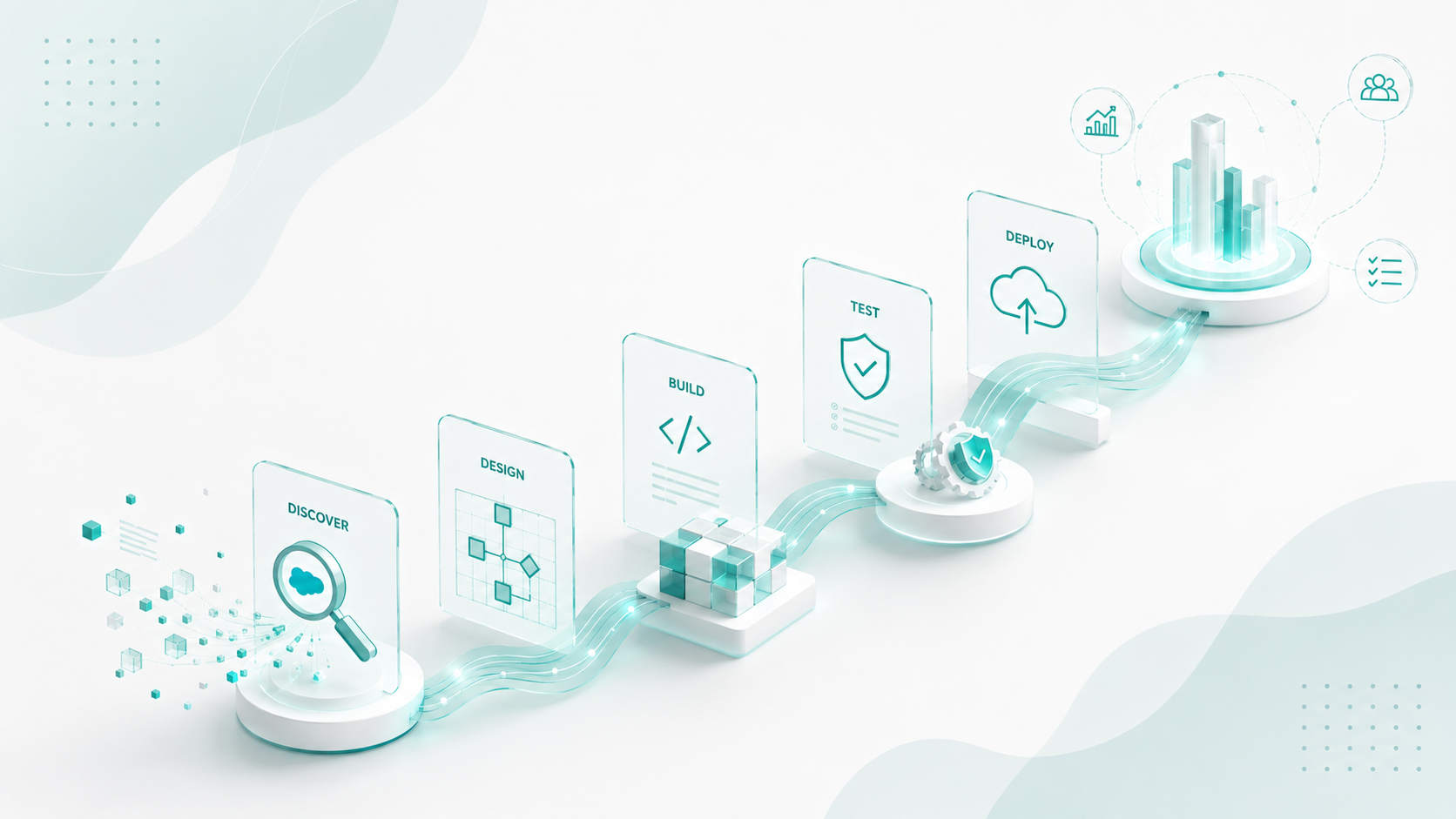
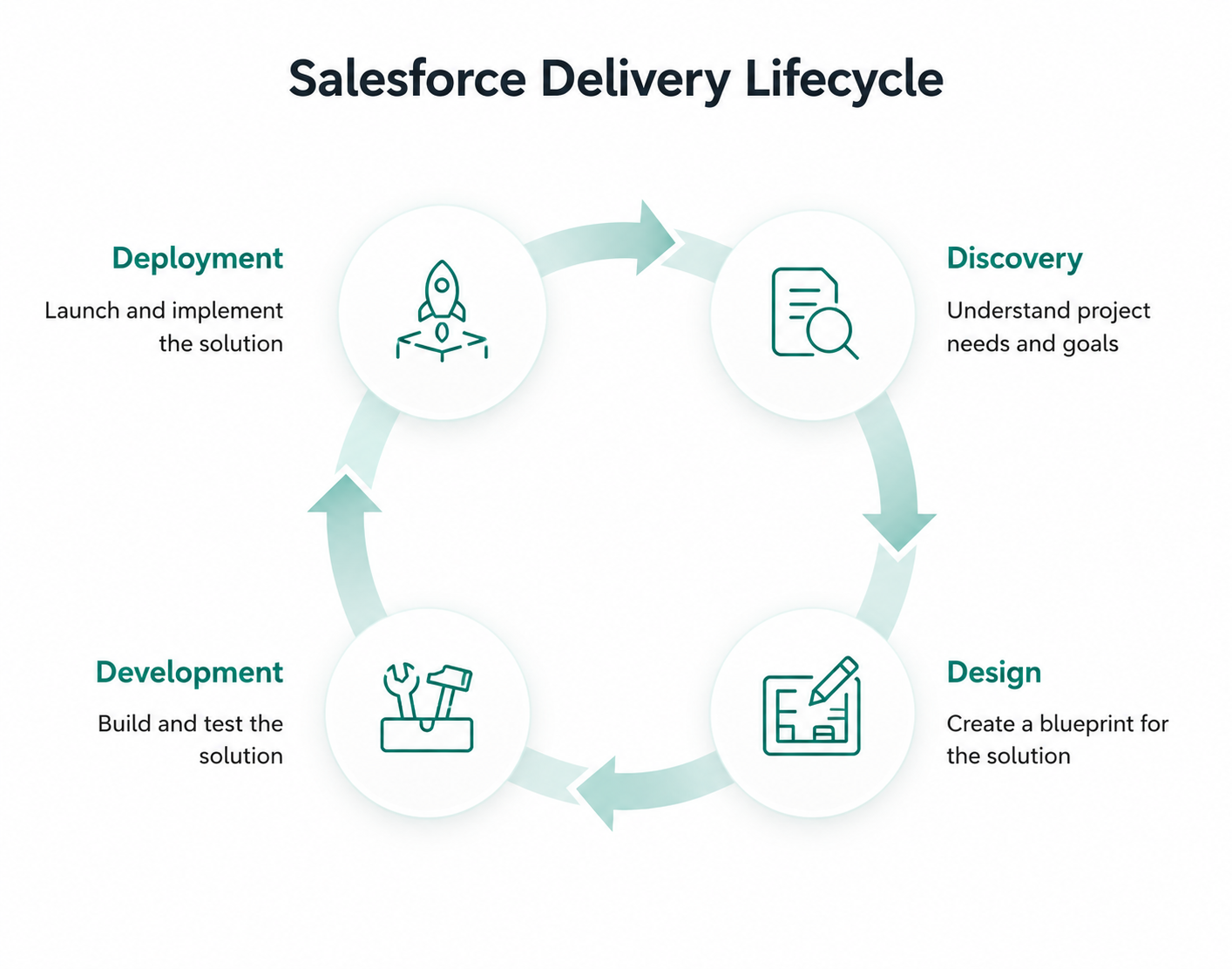
Every SI partner runs roughly the same delivery process.
- First, discovery: gathering requirements across stakeholder groups, auditing the existing org's metadata, and documenting current-state configurations across custom objects, Flows, Apex classes, and permission sets.
- Second, design: mapping requirements to Salesforce capabilities and producing solution design documents that specify objects, fields, Flows, and Apex.
- Third, development: building configurations, writing Apex and LWCs, creating Flows, managing scratch orgs and sandbox environments.
- Fourth, testing and deployment: sandbox validation, CI/CD pipelines, and release management across client orgs.
The process itself is not the problem. The problem is where senior consultant time actually gets spent at each phase, and almost none of it appears explicitly in the project plan.
On a typical Revenue Cloud Advanced engagement, discovery consumes three to six weeks of your best consultant’s time. Not because the work is conceptually hard, but because reverse‑engineering a brownfield org is slow. You are reading metadata, chasing down stakeholders, and reconstructing customizations layered in by multiple partners over the years with incomplete documentation.
Discovery: where senior consultant time goes first
A proper org audit spans custom objects and fields, validation rules, Flows, Apex, permission sets, profiles, installed packages, integration footprints, and field‑level usage. Done manually, that is weeks of work. Skipping depth to save time just pushes the cost downstream as “unknowns” that surface in build.
The cost of incomplete discovery is rework at the most expensive point in the lifecycle. A new Flow that duplicates an existing trigger, a custom object that collides with a managed package namespace, an integration that depends on fields the data model cannot support; these get caught during build or UAT, when every change means refactoring, retesting, and re‑deployment.
Design: the knowledge bottleneck
Solution design is where your most experienced architect becomes the bottleneck. Patterns for Revenue Cloud, CPQ logic, territory models, and multi‑currency setups live in their head, not your methodology. That knowledge does not travel cleanly to the next engagement or the next architect.
Design quality follows the architect assigned, not the standard your practice is supposed to hold.
Junior architects miss dependencies; seniors catch them in review and send work back. Multiply an extra review cycle or two across 10 concurrent programs and you have a structural margin leak that never appears as a line item, but shows up in every engagement’s P&L.
Development and deployment: where hidden complexity lands
Configuration and Apex development rarely move at the pace originally estimated. Custom LWCs take longer than declarative equivalents, CPQ price rules interact in non‑obvious ways, and late‑breaking requirements against a 60%‑built data model force expensive refactors. Scope creep is rarely the story in isolation; it is scope creep landing on top of design and discovery gaps.
Deployment magnifies all of that. Change sets are fragile and blind to dependencies. A single missing field, a permission set tied to a non‑existent record type, or a Flow referencing a deleted field is enough to derail a go‑live window and put a senior developer in the sandbox at 11 p.m.
The CI/CD floor and what’s still missing
Most partners have stabilized the last mile with CI/CD tooling and Salesforce CLI‑based deployments. That is real progress; release failures happen less often and are easier to roll back. But this DevOps layer only lays a foundation for deployment. It does not shorten discovery, it does not standardize design, and it does not generate the configurations being shipped.
The phases that consume most senior consultant time still run on spreadsheets, tribal knowledge, and manual handoffs. Until those are automated and systematized, the ceiling on delivery capacity and margin remains, no matter how reliable your pipelines are.
Also read: How AI-Powered Salesforce Discovery Helps Teams Plan CRM Implementations Faster
Automating Discovery: From Weeks of Workshops to AI-Powered Org Audits
An automated org audit does not replace discovery workshops; it makes them productive faster. When your team walks into the first design conversation already holding a documented picture of the org’s data model, automation footprint, and technical debt, decisions are grounded in facts instead of assumptions.
A thorough automated audit inventories every custom object, field, and relationship, including fill rates that distinguish actively used fields from legacy clutter. It maps validation rules, Flow logic, Apex classes, and triggers to the objects they touch, identifies installed packages and the metadata they control, and surfaces integration footprints across named credentials, connected apps, and external objects. The output is not a dump of raw metadata; it is structured documentation—dependency maps, configuration-to-customization ratios, and technical debt indicators—that every subsequent delivery phase builds on.
On a Revenue Cloud Advanced engagement, this means:
The commercial impact shows up first in pre‑sales. Walking into scoping conversations with a precise view of customization depth, technical debt, and integration complexity means tighter estimates, fewer margin-killing surprises, and fewer “wrong fit” wins where the real effort turns out to be three times what the surface suggested.
This is exactly where the shift toward AI-assisted delivery is starting to change how Salesforce implementations are executed in practice. For instance, HighRev.ai’s Org Intelligence Agent connects to a Salesforce org via OAuth, ingests the full metadata footprint, and generates a structured documentation layer of data models, automation logic, dependency maps, and technical debt indicators within hours, the baseline every other delivery agent builds on.
Automating Solution Design: From Tribal Knowledge to Structured Output
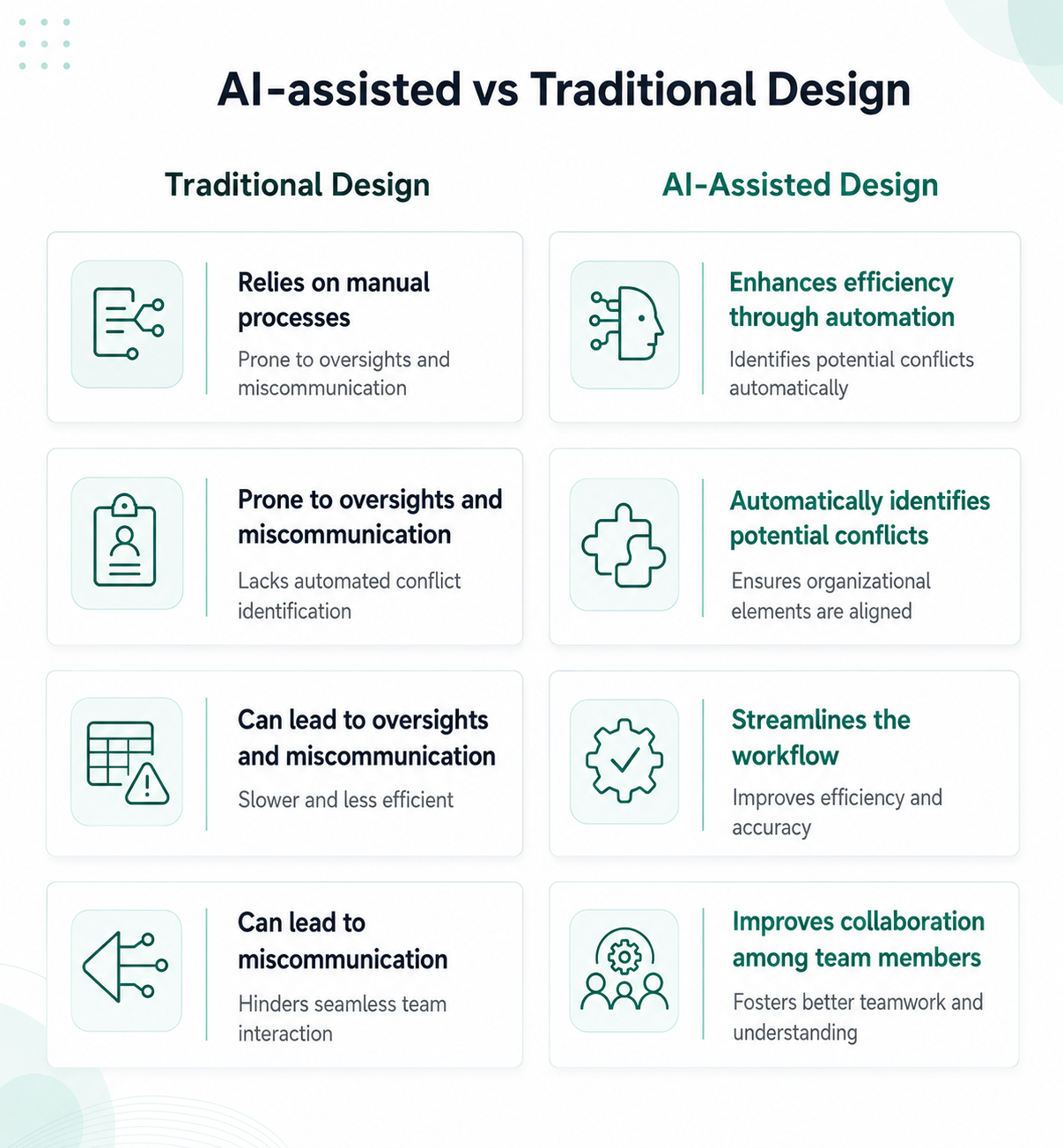
The design phase has a scaling problem that hiring alone cannot solve. Your strongest designs come from your most experienced architects, but you cannot staff them on every engagement, and their patterns often live in their heads rather than in your methodology.
Design inefficiency is expensive because bad decisions compound. A data model that ignores an existing custom object relationship creates rework in development, a security model that clashes with permission sets surfaces in UAT, and CPQ price rules that duplicate existing logic get caught in QA or production.
An AI design agent that cross‑references proposed solutions against the target org’s metadata changes the failure mode. A Flow that duplicates an existing trigger or a data model extension that conflicts with a managed package namespace is flagged before configuration starts, not after sprint work has already been done.
The consistency gain is as important as conflict detection. Junior architects produce design documents that follow the same patterns seniors would use because those patterns are codified in the agent’s recommendations, so design quality becomes a function of your methodology, not individual staffing.
For Revenue Cloud Advanced, where price rules, product attributes, and approval flows are genuinely complex, AI‑assisted design can compress structured artifact creation from weeks to days while keeping your architect in the seat for the judgment calls that still require experience. Based on HighRev.ai's internal delivery data, for example, partners typically see 60% compression in design cycles once the agent is calibrated to their practice patterns.
Automating Development and Deployment: CI/CD, DevOps, and Agentic Implementation
CI/CD pipelines and version control are table stakes for any Salesforce partner operating at scale. They solve deployment reliability, and they are necessary. But as a category, deployment automation platforms and CI/CD-focused tools solve only one phase of the delivery problem. They do not shorten discovery, they do not standardize design, and they do not generate the configurations being shipped. Agentic implementation addresses the earlier gap: producing deployment-ready configurations, Flows, and Apex from approved design specs without starting from a blank file.
Start with the DevOps layer as the foundation, then add agentic development on top to close the gap between design and deployable code.
Multi-org delivery and dependency resolution
Partners running 10 to 30 concurrent implementations face deployment problems that single‑org tools do not solve. Each client org has its own metadata, packages, and edition limits, so a package that deploys cleanly in one org can fail in another because of a conflicting managed package field or a permission set tied to a non‑existent record type. When a deployment does fail, rollback tied to version control history, not a manual undo, is what keeps your go-live window recoverable rather than a four-hour incident.
Automated dependency resolution i.e., mapping every metadata dependency a package requires, validating it against the target org in advance, and surfacing conflicts before the window, is what separates a predictable release process from one that still needs a developer on standby at every go-live. This is the core of any mature Salesforce deployment strategy: validate before you ship, not after.
Salesforce release automation across the delivery lifecycle
Salesforce release automation in a mature DevOps practice covers more than packaging and deployment. It includes automated delta detection between environments, validation-only deployments for pre-flight checks, post-deployment test execution, and rollback capability tied to version control history. For SI partners managing multiple client orgs simultaneously, this means the release management burden does not scale linearly with the number of active engagements, and streamlining Salesforce deployments at this layer directly protects go-live reliability across your entire book of business.
What Multi-Agent AI Means for Your Delivery Practice
A single AI copilot speeds up one person. A multi-agent platform changes how your whole team delivers.
Your senior architects stop being the bottleneck; your junior consultants produce work to a higher standard; and your practice takes on more engagements without proportional headcount growth.
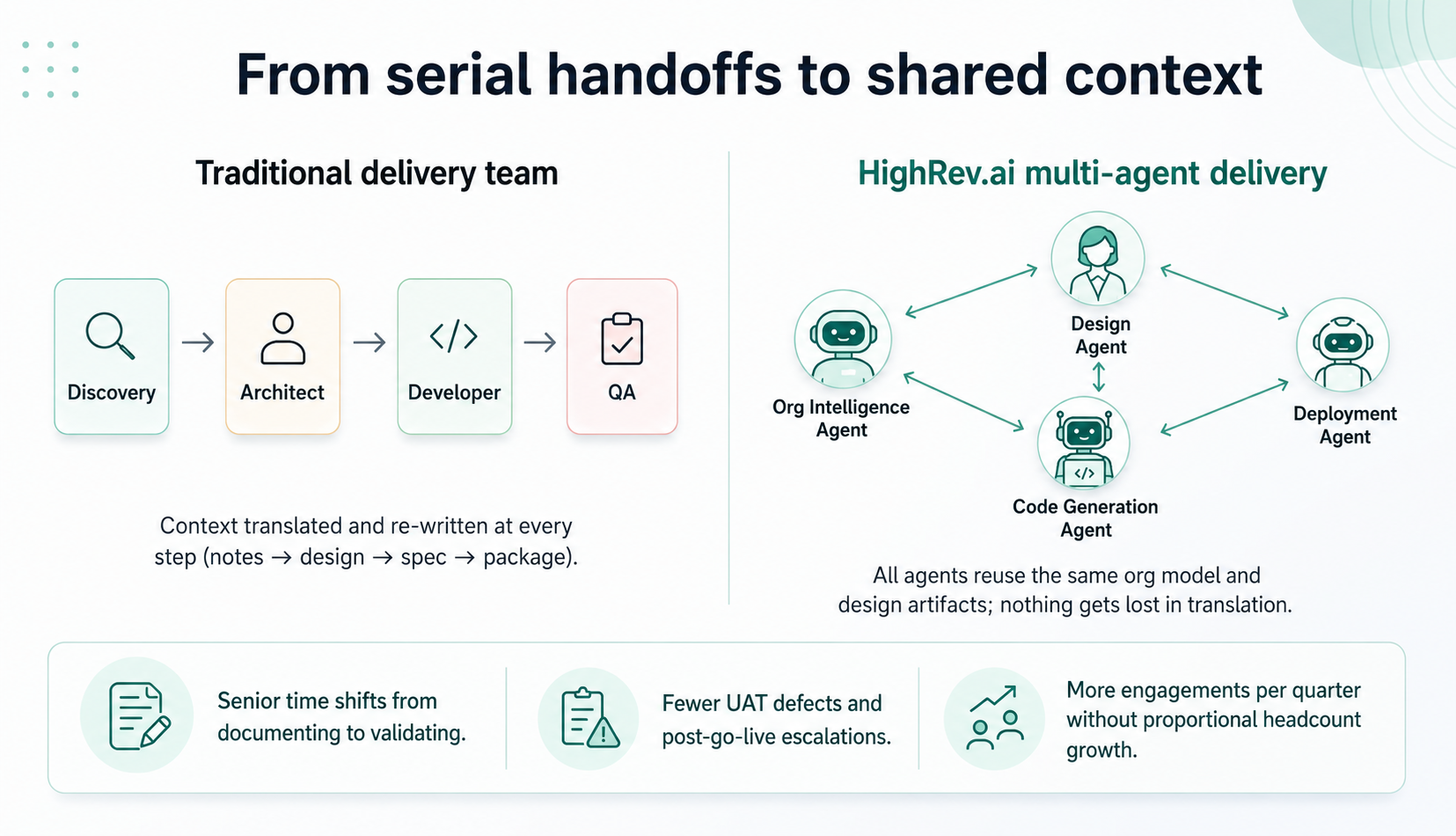
In the HighRev.ai architecture, for instance, discrete specialized agents handle distinct delivery tasks: an Org Intelligence Agent ingests and analyses metadata to produce the discovery baseline, a Design Agent cross-references requirements against that org baseline to generate and validate solution artifacts, and a development agent produces org-aware configurations and Apex from approved design specs. These agents are coordinated across the delivery lifecycle i.e., each one's output becomes the next one's input, so org context is never lost between phases.
This architecture mirrors how delivery teams are actually structured—discovery consultant, solution architect, developer—but removes the serial dependency between them.
Your discovery consultant validates the AI-generated org baseline instead of producing it from scratch. Your architect reviews AI-generated design blueprints and makes the judgment calls rather than authoring every artifact. Your developers review generated packages for business logic and edge cases rather than writing boilerplate from zero. The work that required three people working sequentially can now move in parallel, with senior judgment applied at the validation layer rather than the creation layer.
The commercial impact is direct: faster delivery cycles, higher design consistency across engagements, and the ability to take on more concurrent programs without proportional headcount growth. This is not about replacing consultants. It is about shifting where their expertise is applied: from creating and translating, toward validating and decision‑making. You can see how this plays out in practice:
⇒ See how HighRev.ai’s agents handle discovery, design, and code generation across a live engagement
Building Your Salesforce Delivery Automation Roadmap
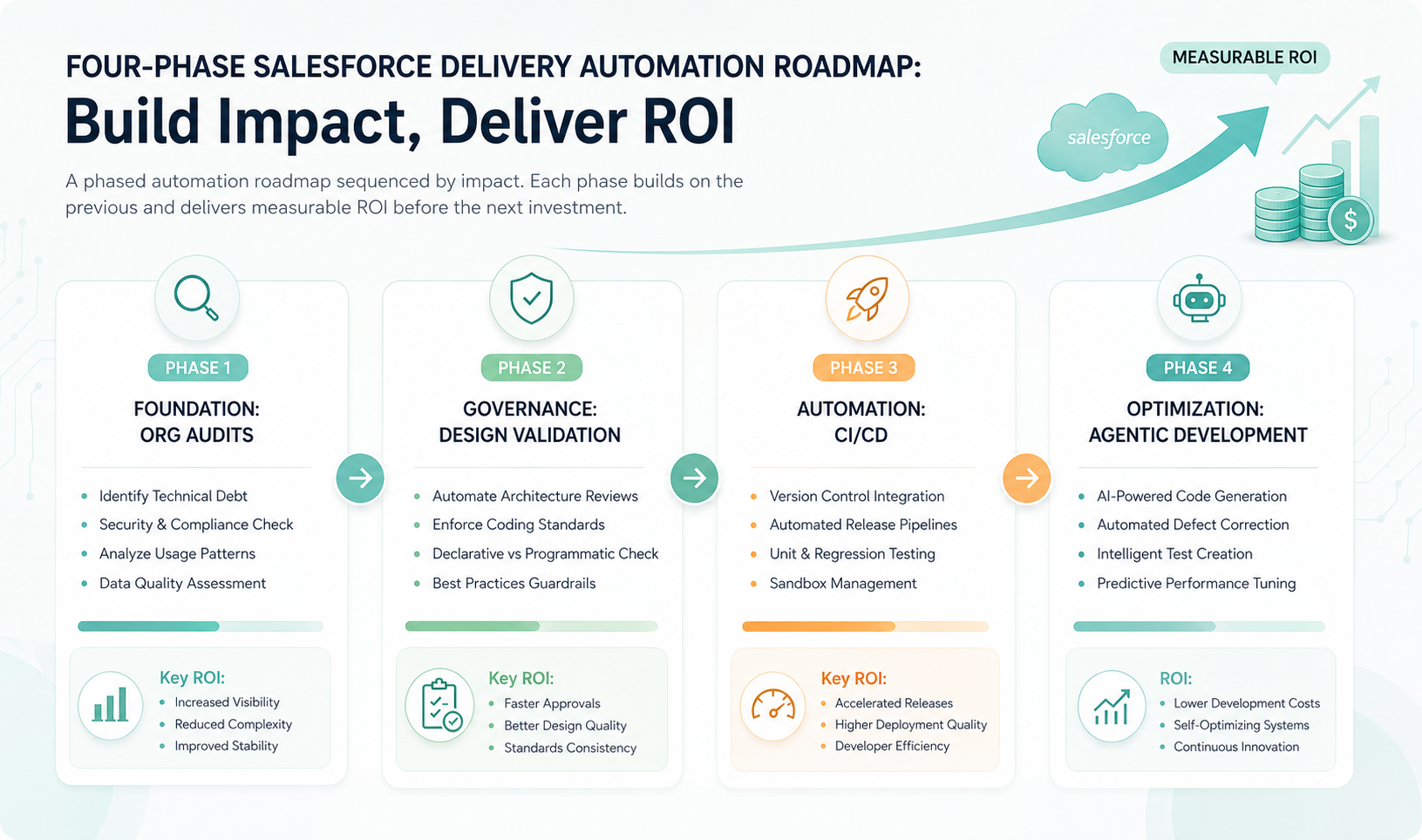
You do not automate everything at once. Start with the phase that creates the most waste, prove ROI, then layer on the next.
Phase 1: Automate org audits
Run an automated org audit for every new engagement before discovery workshops.
Prerequisite: basic org access and OAuth connectivity. No metadata hygiene required upfront; the audit surfaces that work for you.
Expected impact: discovery timelines compress from weeks to hours of automated processing, with structured metadata documentation replacing scattered consultant notes. Pre-sales scoping accuracy improves immediately.
Phase 2: Standardize design and add AI validation
Document your standard design patterns (Revenue Cloud setups, trigger frameworks, Flow vs. Apex rules) and feed them into AI-assisted design validation.
Prerequisite: a baseline methodology document and team buy-in from senior architects, who need to trust and contribute to the pattern library for it to improve over time.
Expected impact: SI partners typically see 30–50% compression in design cycles once calibrated, with fewer missed dependencies reaching the build phase.
Phase 3: Implement CI/CD with automated tests
Migrate from change sets to CLI‑based, source‑tracked deployments with automated Apex tests on every release.
Prerequisite: a one-time metadata hygiene and cleanup phase; pipelines built on top of dirty metadata fail unpredictably. Budget this as a standalone workstream before the pipeline goes live.
Expected impact: measurable reduction in deployment failures and elimination of "all-hands" go-live nights caused by dependency gaps.
Phase 4: Introduce agentic implementation
Once discovery, design, and CI/CD are in place, use agentic generation for repeatable patterns: standard Sales Cloud, Service Cloud, and recurring CPQ structures.
Prerequisite: process maturity in the first three phases. Agentic generation produces the most value when the design artifacts it reads from are consistent and validated.
Expected impact: build time compresses on high-repeat configuration patterns, and developers shift from authoring boilerplate to reviewing and extending generated output.
The four phases are designed to deliver standalone value before the next investment is required. If you have reached Phase 4, your delivery practice is operating at a fundamentally different capacity and margin ceiling than when you started, and that is the outcome the roadmap is built toward.
If you want to see how org-aware agents handle discovery, design, and code generation across a live Salesforce engagement, schedule a demo with HighRev.ai.
Frequently Asked Questions
1. What is the difference between automating Salesforce workflows and automating Salesforce delivery?
Automating Salesforce workflows means building automation inside the platform that runs automatically for your end users. Automating Salesforce delivery means automating the implementation lifecycle that your consulting team performs before and after the platform is configured. The first benefits your client's users. The second protects your delivery practice's margins and capacity.
2. How does AI-powered org discovery reduce Salesforce implementation timelines?
Manual org discovery requires a senior consultant to read and document an org's metadata, including custom objects, Flows, Apex classes, installed packages, and integration footprints. Automated discovery connects to the org via the Salesforce Metadata API, reads the full org footprint, and produces structured documentation in hours, compressing discovery from weeks to days and freeing senior capacity for design and oversight instead of inventory work.
3. What does a Salesforce CI/CD pipeline look like for consulting partners managing multiple client orgs?
A Salesforce CI/CD pipeline for consulting partners starts with metadata in Git, runs validation and automated Apex tests via CLI or a DevOps tool, then promotes approved changes through staging into each client's production org. For multi-org delivery, you standardize the pipeline once and parameterize it per client, so every client follows the same release stages regardless of their org's metadata footprint.
4. Can AI agents generate Salesforce configurations like Flows and Apex, or only assist with deployment?
AI agents can generate Salesforce-specific configurations from approved design specifications. The quality of the output depends on whether the agent has org context: a generic AI assistant generates Salesforce code without knowing the target org. But an org-aware agent that has read the target org's metadata generates output that is validated against the org's existing structure before it is presented for review.
5. How should a Salesforce consulting partner decide which parts of delivery to automate first?
Start with the phase that consumes the most senior consultant time per engagement: org discovery. Automated org audits have an immediate, measurable ROI and a low adoption barrier. From there, move to design validation, then CI/CD, then agentic implementation. Each phase builds on the one before and delivers standalone value before the next investment is required.




