
Salesforce environments continue to grow in complexity as organizations expand automation, integrations, and data models across sales, service, and operations. Over time, many CRM systems accumulate layers of configuration, custom logic, and undocumented dependencies that make it difficult for teams to understand how the system actually works. For delivery teams inheriting these environments, understanding the existing org often becomes a major bottleneck before development even begins.
Industry research highlights the scale of this challenge. According to Deloitte Digital, large Salesforce environments accumulate technical debt through fragmented implementations, excessive customization, and poorly harmonized architectures. As organizations attempt to modernize these systems or adopt AI capabilities, limited system visibility becomes a major operational barrier.
This growing complexity is one of the reasons AI powered Salesforce discovery is becoming an important capability for modern CRM teams. Instead of relying on manual system reviews, organizations are beginning to use AI powered Salesforce discovery to analyze metadata, map relationships between objects and automations, and generate structured insights directly from the Salesforce environment.
This article explores how AI powered Salesforce discovery is transforming the way organizations analyze, document, and understand their Salesforce architecture.
To understand why discovery has become such a critical step in Salesforce delivery, it helps to look at how most enterprise Salesforce environments actually evolve over time. In reality, very few organizations operate in clean, newly built systems.
The Brownfield Reality of Enterprise Salesforce Orgs
Most enterprise Salesforce environments are brownfield systems, not greenfield implementations. Instead of starting with a clean architecture, teams typically work within systems that have evolved over many years.
These environments contain layers of historical configurations and customizations that make analysis more difficult.
Common characteristics include:
- Years of accumulated customizations, including custom objects, fields, and validation rules
- Multiple implementation partners contributing to the system across different phases
- Undocumented automations built using flows, Apex triggers, and other logic
- Legacy integrations connecting Salesforce with ERP platforms, marketing tools, and internal systems
Understanding these environments requires analyzing multiple technical layers such as:
- Metadata structures
- Data models
- Automation logic
- System dependencies
Since these layers are deeply interconnected, manual system analysis can be slow and incomplete.
These characteristics make discovery significantly harder in enterprise Salesforce environments, especially when teams rely on traditional manual analysis.
The Challenges of Traditional Salesforce Discovery
Discovery is essential before any Salesforce implementation, optimization, or migration project. However, traditional discovery methods rely heavily on manual analysis and fragmented tools. In complex environments, this process can become slow, incomplete, and difficult to manage.
Manual org analysis is slow
Understanding an existing Salesforce environment requires reviewing a large amount of metadata and configuration.
Teams need to analyze:
- Thousands of fields across multiple objects
- Hundreds of automations such as flows, validation rules, and triggers
- Large Apex codebases and integrations
In complex enterprise orgs, this level of manual analysis can take weeks before teams fully understand the system.
Industry research highlights how widespread these challenges are. Only 29% of CRM customers have high data quality, which often makes system analysis and documentation difficult during implementation projects.
Limited visibility into system dependencies
Salesforce environments contain multiple layers of automation that interact with each other. Flows, Apex triggers, integrations, and validation rules frequently depend on the same objects and fields.
These relationships are difficult to trace manually, especially when documentation is incomplete. As a result, teams may overlook dependencies that later affect system behavior.
This challenge appears in practitioner discussions within the Reddit Salesforce Community, where administrators often describe inheriting orgs with undocumented automations and unclear system logic.
Fragmented discovery workflows
Traditional discovery relies on multiple disconnected tools. Teams typically switch between different platforms to manage various discovery tasks, including:
- Documentation
- Architecture diagrams
- Requirements analysis
- Development planning
This fragmented approach slows down collaboration and makes it harder to maintain a single source of truth for the system architecture.
Discovery delays impact project timelines
Since manual discovery requires massive effort, it becomes a bottleneck at the start of Salesforce projects.
Extended discovery timelines can delay:
- Project kickoff
- Architecture design
- Implementation planning
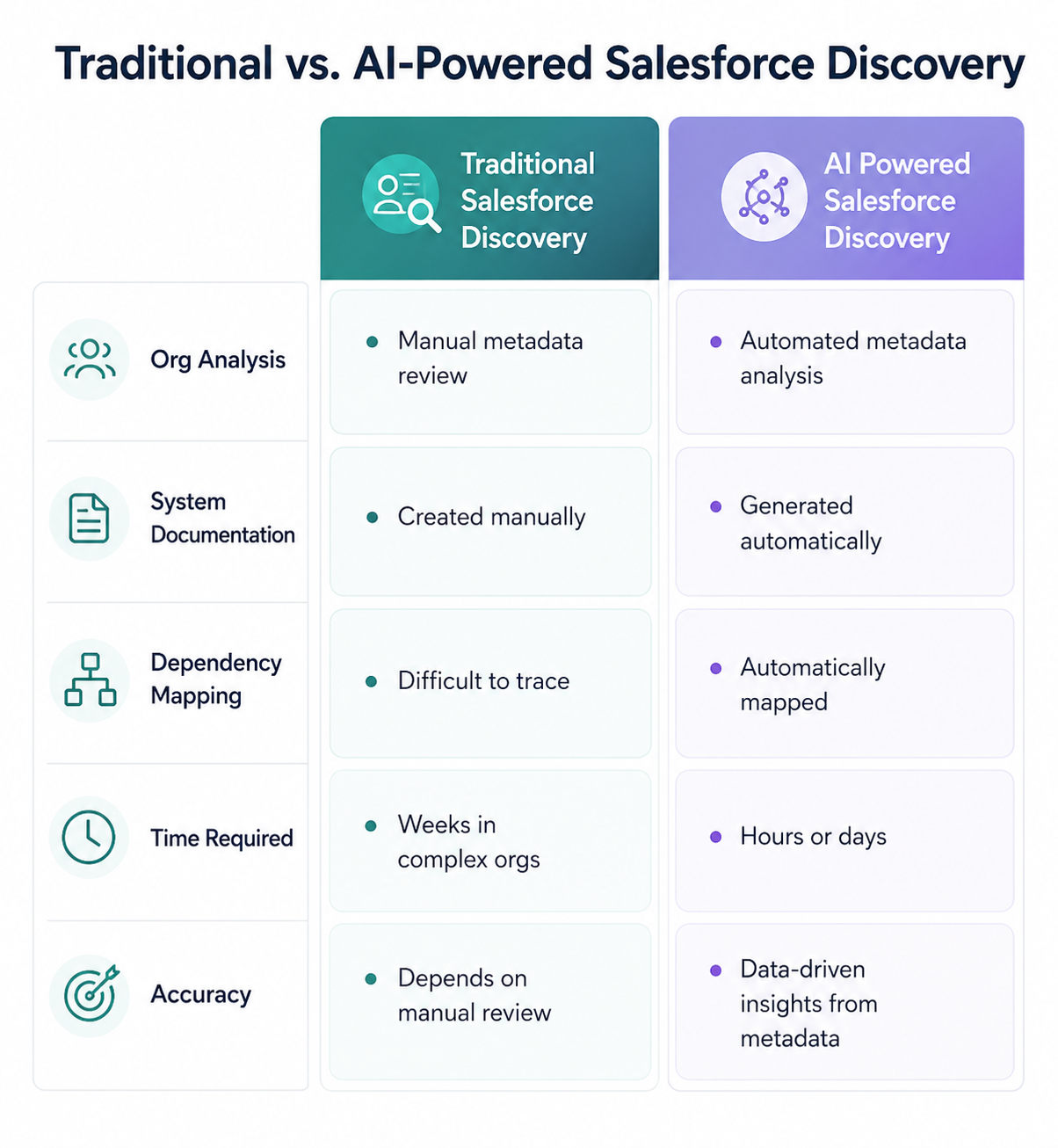
Here's a quick comparison of traditional vs. AI powered Salesforce discovery.
Why Does Discovery Determine Salesforce Delivery Outcomes?
Successful Salesforce projects begin with discovery. Before teams redesign processes, introduce new automation, or implement AI capabilities, they must first understand how the existing Salesforce environment operates.
Research from Deloitte highlights that large Salesforce environments often contain fragmented architectures, legacy customizations, and poorly harmonized implementations. When these elements are not fully understood at the start of a project, hidden dependencies frequently slow delivery and increase implementation risk.
Effective discovery informs several critical aspects of Salesforce delivery:
- Architecture assessment: understanding object models, relationships, and dependencies before making structural changes
- Automation analysis: mapping flows, triggers, and integrations to prevent conflicts with new logic
- Data model evaluation: identifying how data moves across objects and connected systems
- Technical risk identification: detecting legacy code, undocumented automations, and unused configurations
When discovery is incomplete, teams encounter hidden automations, undocumented integrations, and conflicting business logic during development. These late discoveries force redesign, delay delivery timelines, and increase project costs.
How Discovery Translates Into Salesforce Delivery Planning
Discovery creates the foundation for how implementation work is planned and executed. Once teams get visibility into system architecture, automation, and dependencies, they can begin translating those insights into structured delivery plans.
This shift from analysis to execution is where AI powered Salesforce discovery becomes useful. By generating structured insights directly from Salesforce metadata, AI powered Salesforce discovery helps teams move more productively from system understanding to solution planning.
A structured discovery process typically supports three critical stages of implementation.
1. Designing the solution architecture
Once discovery insights are available, architects and solution designers can determine how the Salesforce environment should evolve.
Key design decisions include:
- Data models: Understanding object relationships and data structures helps teams design scalable data models aligned with business processes
- Automation strategies: Visibility into existing flows, triggers, and business logic helps teams introduce new automation without creating conflicts
- Integration approaches: Mapping current integrations helps teams plan how Salesforce will interact with external systems such as ERP platforms, marketing tools, and data warehouses
With a clear understanding of the existing environment, teams can design solutions that align with the current system architecture.
2. Translating requirements into execution plans
Discovery also helps bridge the gap between business requirements and technical implementation.
Once the system context is established, teams can convert requirements into:
- User stories that capture business functionality
- Technical designs that define architecture and automation logic
- Development tasks that guide implementation work
Platforms focused on AI powered Salesforce discovery, such as those developed by HighRev.ai aim to connect discovery insights directly with these downstream planning activities. Linking system analysis with delivery workflows helps teams move from discovery to development more efficiently.
3. Improving implementation predictability
Structured discovery improves project predictability. When teams understand the system early in the lifecycle, they can anticipate dependencies and reduce unexpected technical challenges.
With stronger system visibility, organizations can:
- Plan implementations more confidently
- Reduce redesign during development
- Minimize delays caused by hidden dependencies
As Salesforce environments grow more complex, AI powered Salesforce discovery is helping teams transform discovery into a strategic step that supports more predictable Salesforce delivery.
The Operational Impact of AI Powered Salesforce Discovery
For delivery leaders and project stakeholders, discovery plays a strategic role in Salesforce delivery. It influences project planning, architecture decisions, and implementation timelines. When discovery is slow or incomplete, teams struggle with inaccurate estimates, delayed project starts, and unexpected redesigns during development.
AI powered Salesforce discovery begins to create measurable operational impact. Automated metadata analysis and system mapping help organizations generate reliable insights much earlier in the delivery lifecycle.
Faster project initiation
Traditional discovery can take weeks, especially in complex enterprise orgs. Teams must manually review metadata, automation layers, and integrations before moving forward with planning.
With AI powered Salesforce discovery, much of this analysis can be automated. Teams gain visibility into system architecture faster, allowing projects to move from discovery to planning more quickly.
More accurate project scoping
One of the biggest risks in Salesforce delivery is inaccurate scoping during the early stages of a project. Without a clear understanding of the existing environment, teams often underestimate complexity.
By providing deeper insights into objects, automations, and dependencies, AI powered Salesforce discovery helps teams estimate effort more accurately. This improves confidence when defining project timelines and resource requirements.
Reduced rework during implementation
Hidden dependencies frequently appear during development when discovery is incomplete. These surprises can force teams to redesign automations, modify data models, or adjust integrations mid-project.
With AI powered Salesforce discovery, teams identify these dependencies earlier. This reduces redesign cycles and helps maintain development momentum.
More productive delivery across projects
The benefits of AI powered Salesforce discovery extend beyond a single project. Once organizations adopt automated discovery, they can apply the same insights across multiple initiatives, including system optimization, migration projects, and new feature development.
AI powered Salesforce discovery improves system visibility and reduces manual analysis, helping organizations increase productivity across the Salesforce delivery lifecycle.
Why Generic AI Tools Struggle With Salesforce Delivery
AI tools are rapidly entering software development workflows. Many platforms now assist with documentation, code generation, and diagram creation. However, applying generic AI tools to Salesforce delivery presents a unique challenge. Salesforce environments depend heavily on platform-specific metadata, system relationships, and automation logic that generic AI tools often cannot interpret.
Research from Salesforce highlights that 81% of IT leaders say data silos prevent them from fully leveraging their data, and 62% report that their systems are not configured to support AI initiatives effectively. These limitations stem from fragmented architectures and poor visibility into how enterprise systems operate.
Lack of Salesforce context
Generic AI tools are typically trained to process text or generate code patterns. They do not inherently understand Salesforce-specific structures such as:
- Object relationships
- Field dependencies
- Automation logic through flows and triggers
- Platform security models
- Integrations with external systems
Without analyzing these metadata layers, AI tools cannot accurately assess how system components interact. As a result, insights generated by generic tools often lack the context required for reliable Salesforce analysis.
This challenge frequently appears in discussions within the Salesforce Community and developer forums, where practitioners share how difficult it is to evaluate system dependencies without specialized tools that understand Salesforce metadata.
Code generation without org awareness
Many AI tools focus on accelerating development by generating code snippets or suggesting implementation patterns. While this can improve productivity in isolated cases, it becomes risky when the existing Salesforce org context is unknown.
AI-generated code that lacks awareness of the current system may conflict with:
- Existing flows and triggers
- Validation rules
- Data model constraints
- Integration logic
Without visibility into the full environment, development teams still need to manually verify whether generated solutions align with the existing architecture.
Fragmented AI tools
Another limitation of generic AI tools is that they usually address only a single step in the delivery process.
Common capabilities include:
- Documentation assistance
- Code generation
- Diagram creation
However, Salesforce implementations require coordinated insight across the entire lifecycle. Teams must connect discovery, architecture design, development planning, and system documentation to deliver projects successfully.
AI powered Salesforce discovery enables direct analysis of Salesforce metadata and system relationships, providing the contextual intelligence needed to support discovery, design, and delivery workflows in complex environments.
How HighRev.ai Enables AI Powered Salesforce Discovery
As Salesforce environments grow more complex, teams need reliable ways to understand how their CRM systems operate before making architectural or operational changes. Platforms built specifically for AI powered Salesforce discovery help automate this process by analyzing Salesforce metadata and generating structured insights about system architecture, automation, and integrations.
Unlike general AI assistants that operate as a single model responding to prompts, HighRev.ai uses a multi-agent AI architecture. Each AI agent focuses on a specific stage of the Salesforce delivery lifecycle and shares context with other agents. This allows discovery insights to flow directly into downstream planning and solution design activities.
Here are four ways HighRev.ai enables AI powered Salesforce discovery.
Automated org intelligence and documentation
HighRev.ai analyzes Salesforce metadata to generate a structured view of the CRM environment. This analysis provides insights into:
- Data models across objects and fields
- Object relationships and dependencies
- Automation mappings across flows, triggers, and validation logic
- Integration footprints connecting Salesforce with external systems
These insights form a navigable knowledge base of the Salesforce environment, helping teams understand how system components interact across the organization.
AI agents for org research and system analysis
HighRev.ai provides specialized AI agents that allow teams to query system intelligence directly.
For example, teams can investigate:
- How integrations are configured
- Where specific automations are triggered
- Which objects interact across different business processes
The Org Intelligence Agent analyzes Salesforce metadata and system relationships to answer these questions using real org context. This reduces the need for manual metadata exploration and allows teams to retrieve system insights more quickly.
Architecture risk and technical debt insights
Enterprise Salesforce environments often accumulate technical debt over time. Multiple implementation cycles, evolving business processes, and contributions from different teams can leave behind redundant automation and unused configurations.
HighRev.ai surfaces architectural risks such as:
- Redundant automations that duplicate business logic
- Unused components that increase system complexity
- Dependencies between automations, objects, and integrations that may introduce implementation risk
Early visibility into these issues allows teams to address architectural concerns before development begins.
Context transfer from discovery to solution planning
A common limitation of traditional AI tools is that each interaction operates in isolation. Insights generated in one step of the process often need to be manually transferred into the next stage of implementation planning.
HighRev.ai addresses this through its multi-agent architecture. The Org Intelligence Agent analyzes the Salesforce environment during discovery, while the Solutioning Agent uses that context to support downstream planning activities.
This allows discovery insights to flow directly into:
- User story generation
- Solution architecture planning
- Development task definition
Instead of treating discovery as a standalone activity, HighRev.ai connects system understanding with delivery workflows, helping teams move from system analysis to implementation with greater clarity.
Move from Discovery to Delivery with Confidence
As Salesforce environments grow more complex, translating system understanding into structured delivery plans becomes a critical capability. Teams need reliable visibility into architecture, automation, and integrations before implementing change, and gaining that visibility manually is no longer sustainable at scale.
AI powered Salesforce discovery helps teams generate this visibility faster and with greater accuracy. With structured insights into how a Salesforce org actually operates, teams can move more efficiently from system analysis to solution design and implementation planning.
HighRev.ai supports this transition by connecting org intelligence with downstream delivery workflows. The platform helps teams analyze Salesforce environments, surface architecture insights, and translate discovery findings into actionable delivery plans so projects start with confidence, not assumptions.
Book a demo to see how AI powered Salesforce discovery can help accelerate your Salesforce delivery lifecycle.
FAQs
What is AI powered Salesforce discovery?
AI powered Salesforce discovery uses artificial intelligence to analyze Salesforce metadata, automations, and integrations to understand how an org functions. It helps teams quickly generate system documentation and architecture insights without manual analysis.
How does AI improve implementations?
It gives teams early visibility into dependencies, automation logic, and system structure. This helps improve project scoping, reduce rework during development, and accelerate implementation planning.
Can AI powered Salesforce discovery analyze complex enterprise orgs?
Yes. AI powered Salesforce discovery is especially useful for large Salesforce environments with extensive customizations, integrations, and undocumented configurations.
How does AI reduce technical debt?
It identifies redundant automations, unused components, and risky dependencies during the discovery phase. This allows teams to resolve architectural issues before development begins.
Is AI powered Salesforce discovery useful for consulting partners?
Yes. Consulting partners and system integrators use AI powered Salesforce discovery to accelerate technical discovery during client engagements and create more accurate implementation plans.




