TL;DR
Agentforce Vibes is a developer-level AI coding assistant. It operates in Plan, Act, and Deep Planning modes inside a single Salesforce org. Best for accelerating contained code tasks: Apex refactoring, test class generation, SOQL queries, and formula fields
HighRev.ai is a multi-agent Salesforce delivery platform. It automates discovery, solution design, code generation, and deployment across multiple client orgs. Best for SI partners running enterprise implementations at scale
The two tools can be complementary. Vibes speeds up individual coding tasks. HighRev automates 60 to 70% of the delivery effort that happens outside the code editor: discovery, requirements documentation, solution design, and cross-org coordination
Vibes uses credit-based pricing with token limits that halt processing when those limits are exceeded. HighRev is priced per client org with all delivery capabilities included
Your delivery org has a bottleneck somewhere in the Salesforce implementation lifecycle. The AI tool you choose to address it depends entirely on where that bottleneck sits. Agentforce Vibes is Salesforce’s native AI coding assistant that accelerates individual developer tasks within a single org. HighRev.ai is a multi-agent delivery platform that automates the stages most tools ignore: discovery, solution design, development, and deployment, across every client org your partner practice manages. The platform was built by delivery practitioners who lived these problems firsthand, a story detailed in why HighRev.ai was built. This is a scope question, not a features question. Getting it wrong means months of misallocated budget spent optimizing the wrong phase of delivery.
A note on naming: “Agentforce Vibes” blends Salesforce’s official Agentforce branding with the broader vibe coding movement. Salesforce has used this term in marketing and community contexts, though official product naming may evolve. Throughout this article, we use “Agentforce Vibes” or simply “Vibes” to refer to the AI-assisted coding capabilities within Salesforce’s developer tools.
The breakdown below covers Agentforce Vibes features, HighRev features, pricing models, integrations for both platforms, and honest trade-offs, including HighRev’s current limitations. Written by Salesforce delivery practitioners who have managed 100 or more implementation projects.
Salesforce Partners Are Drowning in Delivery Complexity: AI Promises Help, but Scope Matters
If you run a Salesforce consulting practice with 50 or more certified professionals, the pressure profile looks familiar. Timelines compress while scope expands. Enterprise clients demand faster delivery at lower cost. Senior architects juggle three projects simultaneously while scope creep threatens margins on all of them.
The real cost of Salesforce delivery is not in the coding phase. It sits in everything that happens before code gets written. Typical Salesforce implementation projects spend 60 to 70% of total effort in non-coding phases: discovery, requirements gathering, solution design, and stakeholder alignment. (Source: HighRev.ai internal delivery benchmarks, detailed in the Salesforce implementation costs analysis.) Into that landscape, AI tooling enters the conversation from two directions. Salesforce ships Agentforce Vibes to accelerate developer adoption. HighRev.ai targets the full delivery chain from the first discovery session to the final deployment. Both tools use AI. They address fundamentally different problems.
The distinction that matters for Salesforce consulting partners is not simply “code generation versus discovery automation.” The real challenge is managing the entire delivery lifecycle across multiple clients, orgs, teams, and implementation phases simultaneously.
Tools like Agentforce Vibes primarily focus on developer productivity inside the coding layer. HighRev.ai is designed as a broader Salesforce delivery platform: combining technical discovery, business process mapping, BRD-to-user-story breakdowns, solution and architecture design, metadata-aware development, sprint planning support, documentation generation, and cross-org delivery coordination in one system.
That distinction becomes more important at scale. Most AI coding assistants improve productivity at the individual developer or project level. HighRev.ai is built for Salesforce consulting partners operating at the practice level, where the challenge is not just writing code faster, but running multiple delivery programs with consistency, visibility, and reusable organizational intelligence.
Apex and LWC velocity, a Salesforce AI coding assistant addresses it. If your bottleneck is the effort consumed by discovery workshops, requirements documentation, solution design iteration, and cross-org coordination, you need a different category of tool entirely.
AI tools for Salesforce delivery are multiplying. Picking the wrong category wastes budget and, more critically, months of delivery capacity you cannot recover.
HighRev Covers Discovery Through Deployment. Vibes Covers Code
Agentforce Vibes operates in three modes. Plan Mode generates Markdown implementation plans for code changes. Act Mode proposes edits and executes them with developer confirmation before applying them to the org. Deep Planning inspects the codebase architecture for complex modifications. These are genuinely useful capabilities for developer productivity: writing test classes, refactoring Apex methods, generating SOQL queries, and building formula fields. What Vibes does not address is discovery workshops, business requirements documentation, solution design documents, data modeling decisions, integration architecture, or stakeholder alignment. These are the phases that determine whether a Salesforce implementation succeeds or struggles through rework cycles three sprints in.
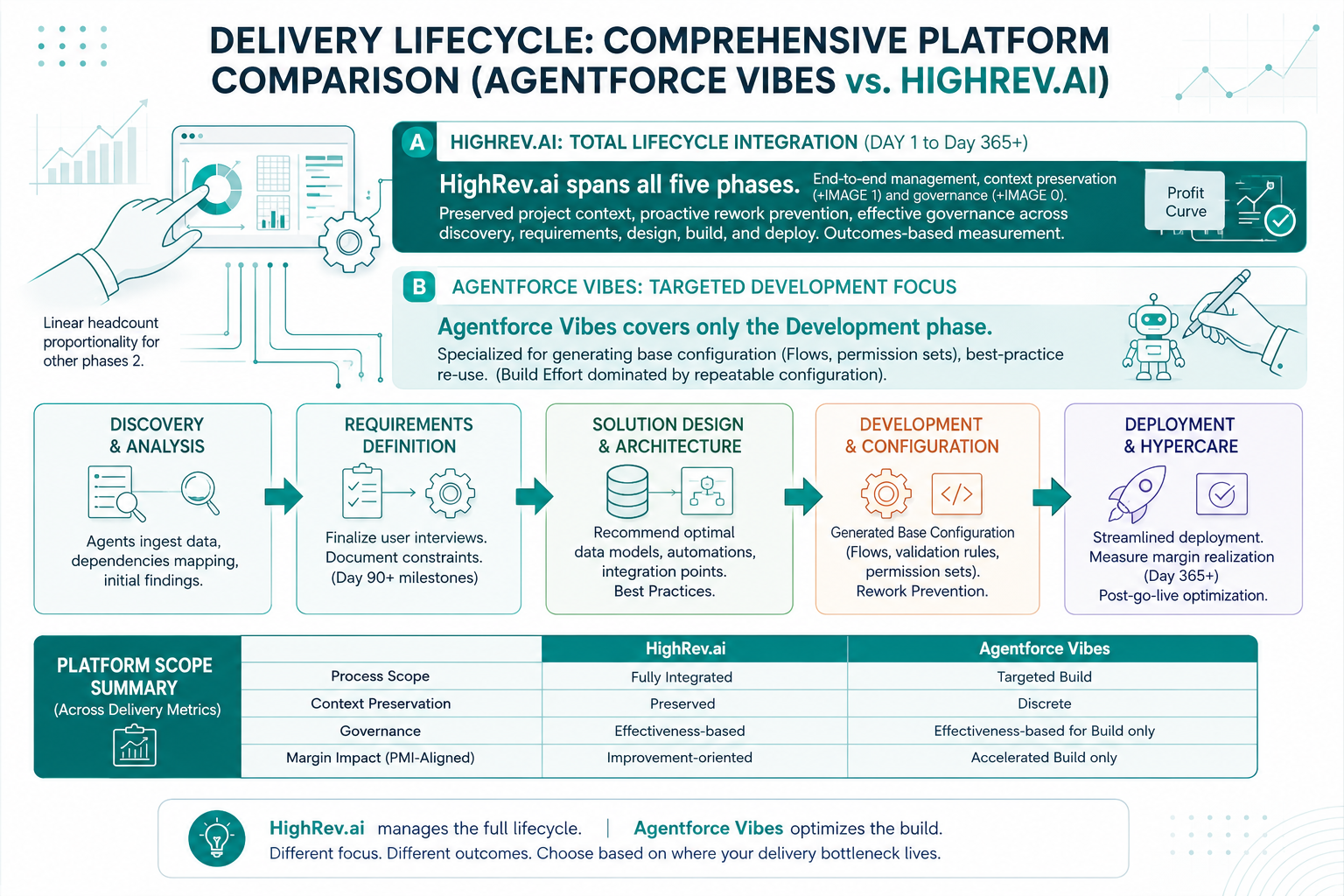
HighRev.ai deploys purpose-built AI agents across each lifecycle stage, with each agent mapping to a senior delivery role. The multi-agent AI platform architecture is what enables context continuity across phases: requirements documented by the Discovery Agent feed into the Design Agent’s solution architecture, and approved design specs flow directly into the Development Agent’s generated code packages. Nothing gets re-entered manually between phases.
Discovery Agent (senior business analyst)
Generates a navigable knowledge base of the entire Salesforce org: data models, objects, and field-level details including fill rates. Catalogs validation rules, automations, integrations, and installed packages, producing the kind of org documentation that typically takes a senior BA two to three weeks of manual exploration. The first discovery session starts with a complete picture of what exists in the org rather than what stakeholders remember to mention.
Design Agent (solution architect)
Takes BRDs and unstructured inputs and turns them into structured user stories with acceptance criteria in approximately five minutes. From there, it produces complete solution designs: data models, automation logic, UI component specs covering LWC and Lightning apps, and security configurations grounded in the org's actual metadata. Architecture decisions account for what already exists before proposing what should change.
Development Agent (senior Salesforce developer)
Generates deployment-ready code packages covering Apex, XML metadata, LWC, Flows, and permission sets, and deploys them directly into the connected org via Metadata API. Human architects review and approve before deployment. The generated output reflects org-specific constraints rather than generic Salesforce patterns.
Why a platform beats a collection of point tools
Partners who have tried to replicate this with Claude or other general-purpose AI tools consistently run into the same wall. You can share context with Claude and build specific agents for discrete tasks. What you cannot do is build and maintain an entire delivery process as a managed workflow, with improving feature sets across the workflow, evolving intelligence per phase, consistent quality enforcement across every engagement, and a maintenance model that does not land on your internal team.
The bottlenecks partners call out are structural, not technical. Who owns prompt engineering as Salesforce releases new metadata types? Who updates the discovery agent's understanding when Revenue Cloud Advanced adds new configuration surfaces? Who maintains consistency between the design agent's output standards and the development agent's code generation patterns as both improve over time? With point tools, every one of those questions becomes an internal engineering problem your delivery team now owns.
HighRev absorbs that maintenance and improvement burden entirely. The platform is updated continuously: new Salesforce metadata types, improved agent reasoning, refined design patterns, without requiring your practice to manage any of it. Your team inherits the improvements on every engagement without building or maintaining the underlying system.
The commercial consequence of this distinction is significant. Vibes and Claude are implemented at the project level or the individual client level at most. HighRev is implemented at the practice level. Individual developer productivity versus overall practice productivity gains are not the same metric, and the investment case for each is entirely different. A practice that improves individual developer velocity by 30% on one project gains 30% on that project. A practice that implements a delivery platform across all 15 concurrent engagements compounds that advantage across the entire portfolio, and the advantage grows as the platform improves.ck.
Built for Partners Running 10 or More Orgs Simultaneously
Salesforce consulting partners do not work in a single org. On any given week, your delivery team is likely active across a dozen client environments, each with its own sandbox strategy, metadata complexity, deployment cadence, and inherited technical debt.
Agentforce Vibes is tied to a single org context per session. It operates with credit-based token limits, and exceeding those limits halts processing mid-task. The developer has to manually decompose the remaining work into smaller chunks and re-engage. For a single developer on a contained task within a single org, this is workable. For a delivery organization running concurrent enterprise implementations, it introduces friction that compounds across every active project. HighRev.ai is architecturally designed for the partner use case. The platform supports multi-org connectivity across production, sandbox, and dev environments for different clients, with no per-task token ceilings. More on how multi-org overhead inflates delivery budgets in the Salesforce implementation costs analysis.
One caveat worth noting: HighRev currently focuses on Advanced implementations of Sales Cloud, Service Cloud, and Revenue Cloud. Partners whose practice centers on Marketing Cloud, Tableau, or MuleSoft work will not find the same depth of metadata-native support today. Agentforce Vibes performance holds up well for its intended use case: one developer, one org, one task. HighRev performance is measured at a different level entirely: delivery capacity across an entire practice portfolio.
HighRev Agents Understand Your Org. Vibes Generates Code.
Agentforce Vibes brings strong developer workflow capabilities: multi-model support across several foundation models with additional options in the Pro tier, Rules and Skills for preloaded guidance and custom instructions, MCP tools for third-party integrations, and a code analyzer that catches security issues. These Agentforce Vibes integrations and features add real value for developers working on specific coding tasks, and dismissing them would be dishonest.
The core distinction lies in how each tool understands the Salesforce org it works with. Vibes’ intelligence is code-centric: it reads the codebase, generates plans, and writes or edits code within that context window. HighRev’s agents reason at the metadata layer, across relationships between custom objects, field dependencies, Flow logic, permission hierarchies, validation rules, and existing Apex triggers. This understanding persists across the entire delivery lifecycle, so every agent action reflects the actual state of the org, not just the code files visible in a single session.
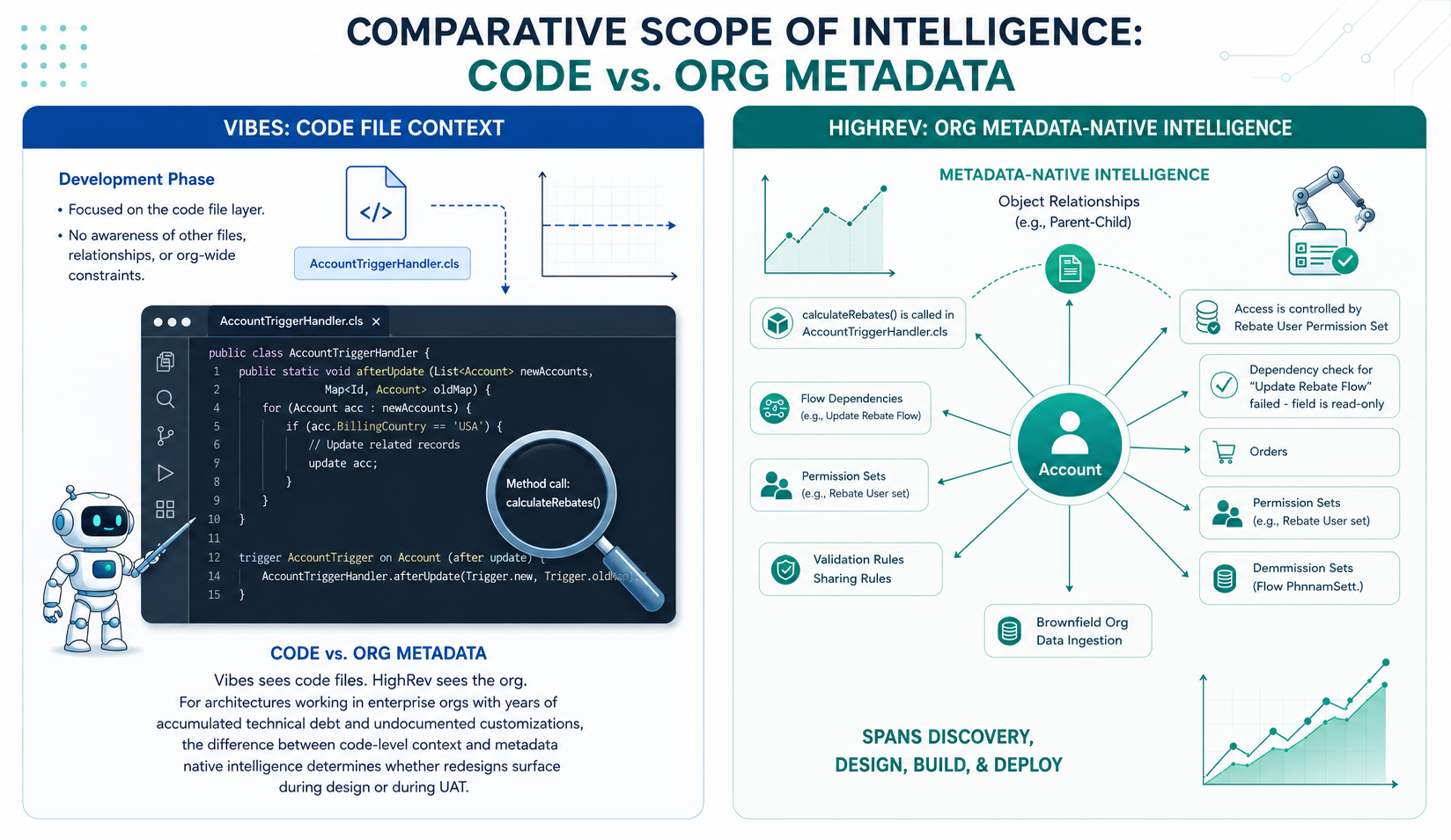
Let us consider a concrete example:
When HighRev’s Design Agent encounters a CPQ implementation with custom price rules, it factors those existing configurations into the solution design before any code is written. Dependencies between price rules, product bundles, and existing Apex triggers inform the recommended architecture. A code assistant requires the developer to manually surface and provide that context. Most developers do not have complete visibility into the complexity of brownfield orgs on their first day, or even in their first month.
HighRev’s org-aware intelligence draws from actual Salesforce standard and custom objects, field-level details, validation rules, automations, integrations, and installed packages. For architects and lead developers working in enterprise orgs with years of accumulated technical debt and undocumented customizations, metadata-native intelligence is the difference between confident solutioning and redesigns discovered three sprints too late. The technical architecture behind this approach is detailed in the HighRev.ai blog.
Predictable Platform Pricing vs. Token-Metered Credits
Agentforce Vibes pricing follows a credit-based consumption model today. Costs vary by mode (Plan, Act, Deep Planning), model tier (Pro versus Core), and task complexity. Salesforce has not published fixed per-license costs, making it difficult to budget accurately for partner orgs running AI-assisted development across multiple projects.
That may be about to change materially. Based on what partners in the Salesforce ecosystem are reporting, Salesforce is moving toward a per-user pricing model for Agentforce Vibes, with figures circulating around $125 per user per month on top of token-based consumption charges, potentially effective from June 2025. This has not been officially announced. But if it holds, the economics shift significantly: a 15-person delivery team using Vibes across active projects could be looking at costs comparable to a full Salesforce license per seat, before token consumption is factored in.
We will update this section when Salesforce publishes official pricing. In the meantime, any budget planning that treats Vibes as a low-cost or included tool should account for the possibility that per-seat charges are coming up.s.
The operational concern extends beyond cost. When credits deplete or token limits are exceeded mid-task, work stops. A developer in the middle of a complex refactoring job has to pause, break the remaining work into smaller pieces, and restart each sub-task individually. The interruption carries a compound cost: lost developer flow state, timeline slippage, and delivery managers adjusting plans around unplanned delays.
HighRev pricing is structured for the partner business model. The platform is priced per client org onboarded, with all capabilities included: discovery, design, development, and deployment agents. No separate charges per agent, per mode, or per task. A free trial is available for evaluation. When most project effort sits outside the code editor, a credit-based coding tool addresses only a fraction of the total cost structure. A delivery platform that automates discovery, design, and development with predictable pricing addresses the full margin equation.
Explore how HighRev.ai pricing works for your practice: Schedule a Demo.
Feature by Feature: Agentforce Vibes vs. HighRev.ai
The table below covers confirmed capabilities for each product. Where details are not publicly documented, that is stated directly rather than inferred.
The table makes the Agentforce Vibes vs HighRev comparison concrete. Vibes is strong in its lane: Salesforce AI coding assistance for individual developers working on contained tasks. Agentforce Vibes benefits are real and should not be discounted for that specific use case. HighRev benefits extend across the delivery phases where most project effort and cost actually accumulate. Weighing Agentforce Vibes pros and cons against HighRev pros and cons is less about which product is better and more about which one addresses your specific delivery bottleneck.
How Salesforce Partners Use HighRev.ai to Accelerate Delivery
HighRev.ai is an early-stage platform. Published case studies with named client logos are limited at this point, and there’s no reason to obscure that. What exists is the operational pattern emerging from partner pilots and the delivery experience of HighRev’s founding team. The founders built HighRev.ai from firsthand experience managing large-scale Salesforce implementations: the kind where discovery phases ran over budget because nobody documented the client’s existing automation rules, and solution designs required rework after hidden dependencies surfaced mid-project. That origin story is documented in the why HighRev.ai was built founder’s note.
Here is the delivery pattern the platform addresses:
Representative scenario: A mid-size Salesforce SI with 80 certified professionals manages 12 concurrent implementations across Sales Cloud and Revenue Cloud Advanced. Discovery phases alone consume 40% of project timelines. Requirements documentation is inconsistent between engagement teams. Architects are stretched across multiple projects, reviewing designs they had insufficient time to produce thoroughly.
After deploying HighRev.ai’s Discovery and Design Agents, the partner reduces requirements documentation effort from weeks to days per engagement. Automated org audits remove redundant manual analysis. Solution designs are grounded in actual org metadata rather than incomplete stakeholder interviews. Developers receive deployment-ready packages tied to approved architecture. The operational impact: shorter timelines, fewer late-stage redesigns, and senior architects freed from repetitive discovery work to focus on high-judgment architectural decisions that actually require their expertise.
See how HighRev.ai works for your delivery org: Schedule a Demo.
Your Delivery Org Deserves More Than a Code Assistant
The honest framework for choosing between these tools:
If your only pain point is developer velocity on individual coding tasks, Vibes is a capable tool for that specific job. Salesforce built it well within its scope. If your bottleneck is delivering entire Salesforce implementations faster, with fewer senior architects stretched thin, cleaner discovery documentation, and stronger gross margins across your project portfolio, you need a delivery platform built for partner-scale operations. One tool accelerates individual tasks. The other accelerates your delivery org.
Book a HighRev.ai Demo — or read the Founder’s Note for the delivery experience behind the platform.
Frequently Asked Questions
1. Can Agentforce Vibes and HighRev.ai be used together, or are they mutually exclusive?
The two platforms are complementary rather than mutually exclusive. Vibes operates at the individual developer level for code-specific tasks; HighRev operates at the delivery org level across multiple client projects. In practice, a partner can use HighRev to manage the full delivery lifecycle, covering discovery, design, development, and deployment, while individual developers use Vibes for contained coding tasks like writing test classes, refactoring Apex, or generating SOQL queries within that workflow. There is no technical conflict between the two platforms.
2. Does HighRev.ai support Revenue Cloud Advanced implementations, or is it limited to Sales and Service Cloud?
HighRev.ai supports Sales Cloud, Service Cloud, and Revenue Cloud Advanced implementations. The platform’s org-aware intelligence reads metadata specific to each cloud, including RCA price rules, product configurations, and CPQ-related customizations, and factors them into discovery documentation, solution designs, and generated code packages. Other Salesforce clouds, including Marketing Cloud, Tableau, and MuleSoft, are not currently supported at the same depth.
3. How does HighRev.ai handle Salesforce metadata context differently from Vibes’ Plan and Deep Planning modes?
Vibes’ Plan and Deep Planning modes analyze the codebase to generate implementation plans and architectural assessments for code changes. HighRev’s agents reason across the full metadata layer: object relationships, field dependencies, fill rates, Flow logic, permission hierarchies, validation rules, integrations, and installed packages. This metadata understanding persists across the entire delivery lifecycle, from discovery through deployment, so every agent action reflects the actual state of the org rather than only the code files visible in a single session.
4. What happens when Agentforce Vibes hits its token or context limit mid-implementation on a complex project?
Processing halts. The developer must manually decompose the remaining work into smaller tasks that fit within the token ceiling and re-engage the tool for each sub-task. On complex enterprise implementations with large codebases, this interruption can occur frequently enough to disrupt development flow and introduce timeline risk. HighRev.ai does not impose per-task token ceilings, allowing agents to operate across complex org contexts without mid-task interruptions.
5. Is HighRev.ai built for individual developers, or specifically for Salesforce consulting partner delivery teams?
HighRev.ai is purpose-built for Salesforce consulting and implementation partners: organizations that own delivery outcomes and P&L across multiple client engagements. The platform includes multi-project management, multi-org support, role-based access, and shared memory across company, clients, orgs, and users. Individual developers benefit from the Development Agent’s code generation capabilities, but the platform’s architecture, pricing, and workflow design serve the delivery team as a whole rather than a single practitioner. To evaluate whether it fits your delivery org, request a personalized HighRev.ai walkthrough.




