TL;DR
- AI-powered Salesforce implementation introduces intelligence across discovery, design, and development, replacing manual org audits and documentation-heavy workflows.
- Traditional Salesforce delivery slows down due to manual discovery, fragmented documentation, and context loss between business analysts, architects, and developers.
- AI improves implementation by analyzing org metadata, generating structured requirements, validating solution design, and producing deployment-ready artifacts.
- The result is faster discovery, reduced rework, more predictable delivery timelines, and stronger margins for Salesforce implementation partners
Discovery often begins with spreadsheets, screen recordings, and hours inside Salesforce Setup. Architects trace undocumented objects, flows, Apex triggers, and integrations to understand how the org actually works. Business analysts convert stakeholder conversations into requirements, and developers interpret those documents to build configuration, automation, and code.
Each handoff introduces context gaps. Requirements are reinterpreted, assumptions accumulate, and rework becomes part of the delivery cycle.
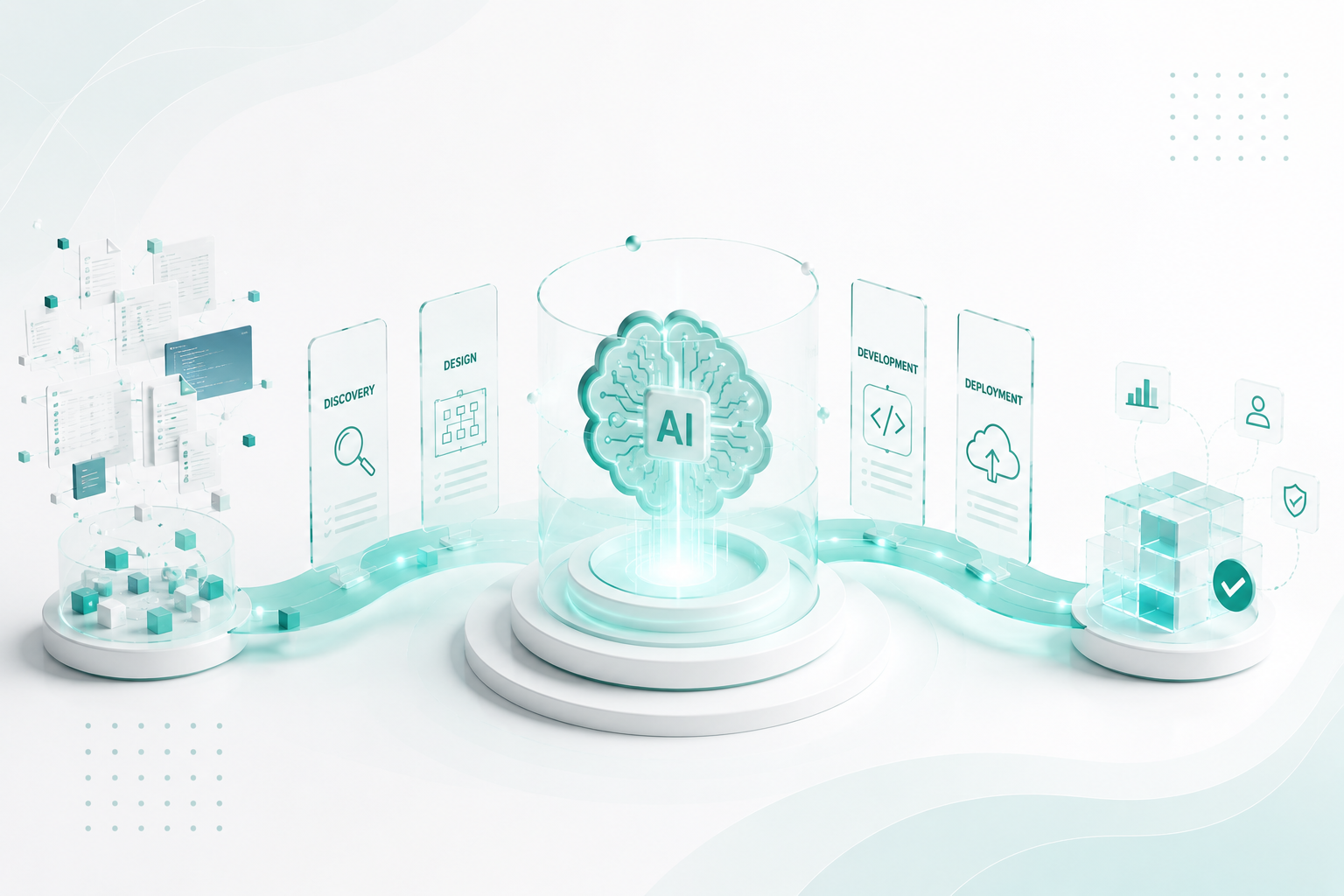
AI-powered Salesforce implementation changes this model. Instead of relying on disconnected documentation and manual analysis, AI introduces system intelligence across the delivery lifecycle. Org metadata can be analyzed automatically, requirements can be structured from stakeholder inputs, and solution designs can align directly with real org constraints.
For Salesforce SI partners and enterprise delivery teams, this shift is about reducing ambiguity between lifecycle stages and creating continuity from discovery to deployment, rather than replacing developers and architects.
In this guide, we cover:
- Where traditional Salesforce implementation loses time and margin
- How AI-powered Salesforce implementation works in practice
- The difference between point AI tools and unified delivery platforms
- What to evaluate before introducing AI into your implementation model
The Traditional Salesforce Implementation Model and Why it Slows Delivery
Salesforce implementations still follow a largely sequential delivery model. Discovery, design, and development are typically owned by different roles and connected primarily through documentation rather than shared system intelligence.
For Salesforce implementation services providers and SI partners, this structure introduces friction as project complexity grows. Teams repeatedly reconstruct context from previous documentation instead of working from a shared understanding of the Salesforce org.
As a result, delivery teams spend a significant portion of project time rebuilding system context before meaningful implementation work begins.
Where time and risk accumulate in Salesforce implementation
Understanding how traditional implementations operate helps explain why delays, rework, and extended timelines are so common.
Discovery
In brownfield environments, discovery is inherently resource-intensive. Architects manually audit objects, fields, flows, Apex triggers, validation rules, integrations, and security models to understand how the org operates.
This process is not just complex, it is time-bound by the need for accuracy. High-quality discovery requires careful, methodical analysis, which takes significant time when done manually. Documentation is often incomplete or outdated, and hidden dependencies frequently surface only after deeper analysis.
In many cases, estimation begins before teams have full technical visibility into the system. When technical constraints appear later in development, timelines shift and scope must be adjusted.
Design
Business analysts translate stakeholder discussions into BRDs and user stories, while technical architects convert those requirements into solution design documents.
These artifacts typically exist outside the Salesforce org, so alignment depends heavily on documentation quality rather than direct awareness of existing configurations, automation, and integrations. Producing high-quality, implementation-ready documentation is itself a time-intensive process, requiring multiple iterations and reviews.
Requirements pass through multiple interpretation layers before reaching development, increasing both effort and the risk of misalignment.
Development
Developers configure objects, build flows, write Apex code, and deploy changes across environments while interpreting design documents along the way.
Even with skilled teams, ensuring quality requires careful validation against both requirements and actual system behavior. This introduces additional cycles of testing and verification, which extend timelines when done manually.
Gaps between documented intent and real system behavior often surface during QA or UAT, triggering revision cycles. Rework becomes a natural outcome of both context loss and the time constraints of manual execution.
In enterprise projects with large teams, maintaining consistent development standards and quality becomes challenging. Variations in experience and interpretation can lead to inconsistencies in how solutions are implemented. AI can help introduce governance and standardization by guiding developers toward consistent patterns and best practices across the codebase. As one partner noted, the goal is to bridge the gap between the strongest and least experienced developers, ensuring more uniform quality across the team.
Structural challenges in traditional Salesforce implementation
Several structural factors compound these issues as projects grow in complexity.
Manual discovery in inherited environments
In brownfield orgs, architects rely on manual metadata audits to understand existing configuration and automation. High-quality analysis takes time, yet project timelines often push teams to move forward with partial visibility. Hidden dependencies frequently emerge after development has already begun.
Context loss across delivery roles
Requirements move from stakeholder conversations to BRDs, then to user stories, and finally to technical design documents. Each transition requires time for interpretation and validation. Developers ultimately implement these artifacts inside the org, introducing gaps between intent and execution.
Rework and timeline overruns
When discovery gaps and design inconsistencies reach development, configuration changes, flow redesign, and Apex modifications become necessary. Regression testing expands accordingly. Much of this rework reflects the reality that quality validation, when done late and manually, adds significant time to delivery.
Linear scaling and margin pressure
Traditional Salesforce implementation scales primarily through headcount. As complexity increases, teams add more architects, developers, and QA resources to maintain delivery velocity.
However, manual, quality-driven work does not compress easily. Revenue grows with delivery volume, but costs rise at nearly the same rate. When rework expands and timelines slip, delivery margins tighten.
The Current State of AI in Salesforce Implementation
AI adoption is expanding across enterprise software delivery. Research from McKinsey & Company shows that 88% of organizations now report regular AI use in at least one business function, up from 78% a year ago.
At the same time, developer ecosystems are rapidly integrating AI-assisted tooling. The GitHub Octoverse highlights widespread adoption of AI-assisted development tools, along with measurable gains in productivity and task completion speed.
Within the Salesforce ecosystem, early AI initiatives focused on intelligence embedded directly within the CRM product. Salesforce Einstein introduced predictive analytics, forecasting insights, and recommendation engines inside CRM workflows, helping sales, service, and marketing teams interpret customer data more effectively after implementation.
Most recent platform developments extend AI beyond embedded CRM intelligence. Agentforce reflects a shift toward AI-driven orchestration of tasks, actionable insights, and operational processes across enterprise systems.
A similar shift is now unfolding within the Salesforce implementation process itself.
AI capabilities are increasingly applied across delivery stages. Discovery benefits from automated metadata analysis and org scanning. Requirement documentation improves through structured user story generation. Solution design aligns with real org constraints, existing automations, and integration patterns. Build preparation can generate configuration artifacts directly from validated designs.
Together, these capabilities introduce shared system intelligence across the Salesforce delivery lifecycle. Discovery, design, and development operate with consistent technical context drawn directly from the org.
For Salesforce SI partners managing complex programs, this model creates a more structured implementation process. Teams gain earlier visibility into dependencies, clearer requirement definition, and stronger alignment between design intent and deployed configuration.
How AI Powered Salesforce Implementation Reduces Delivery Risk
AI-powered Salesforce implementation reduces delivery risk by strengthening continuity across the delivery lifecycle. Instead of optimizing isolated tasks, it improves how discovery, design, and development connect.
Faster org-aware discovery
Delivery risk often begins with incomplete visibility. AI-driven org analysis surfaces objects, flows, Apex, integrations, and dependencies early in the project. This enables teams to automate repetitive tasks, reduce manual analysis, and apply AI tools effectively across the discovery stage.
This reduces uncertainty and helps limit mid-project surprises that delay implementation.
Structured requirement generation
Requirement ambiguity is a major source of rework. AI can convert stakeholder inputs, transcripts, and legacy documentation into structured user stories with traceable acceptance criteria.
Standardized requirements improve handoffs between business analysts, architects, and developers while increasing estimation confidence.
Context-aligned design
Traditional solution design often lives in static documents. AI-powered systems align requirements with real org metadata and flag conflicts before development begins. Architects design within actual constraints rather than assumptions.
This improves design accuracy and reduces change requests during QA and UAT.
Deployment-ready build outputs
In development, AI can generate configuration artifacts and build logic mapped directly to approved designs. Developers work from structured, traceable inputs rather than reconstructing intent from documentation.
The impact compounds across the lifecycle. Reduced rework shortens timelines, improves estimation reliability, and helps delivery teams protect margin by avoiding unplanned effort.
For SI leaders, AI-powered Salesforce implementation becomes a control layer across delivery rather than a standalone productivity tool.
Business Impact and Customer Outcomes of AI-Driven Salesforce Implementation
AI-driven Salesforce implementation changes the operating model for SI partners. The impact shows up in delivery velocity, utilization, and gross margin across the Salesforce delivery lifecycle.
Shorter discovery cycles
In traditional delivery, brownfield discovery can take weeks. Architects manually audit objects, flows, Apex classes, validation rules, integrations, and installed packages before solutioning begins.
With automated org documentation and an org aware discovery co-pilot, brownfield understanding compresses from weeks to hours. Hidden dependencies surface early. Technical debt is visible before estimates are locked.
Shorter discovery cycles reduce early stage uncertainty and create a stronger foundation to reduce Salesforce implementation time.
Quicker design turnaround
Business analysts often spend days synthesizing BRDs, transcripts, and workshop notes into structured user stories. These include features, acceptance criteria, and both functional and non-functional requirements.
Architects then generate context-aware solution designs tied directly to the connected org’s metadata, including data models, automations, UI components, and security.
This removes the blank page phase and accelerates the transition from requirement to execution ready design.
Reduced rework during build
Rework typically occurs when design assumptions conflict with an organization's actual Salesforce structure. Aligning user stories and solution designs with org setup before development can prevent these issues.
From approved designs, specialized platforms generate deployment-ready code packages. These include XML metadata, Apex classes, Lightning Web Components, flows, layouts, and permission sets. They validate compilation, resolve errors, and deliver a final package ready for deployment.
This results in fewer gaps reaching QA, declining change requests, and narrower timeline variance.
Improved utilization across roles
Architects spend less time on manual org research. Business analysts reduce time spent drafting baseline documentation. And developers receive structured, context aware inputs rather than static design documents.
Delivery effort shifts from reconstruction and correction to execution, boosting productivity, improving resource allocation, and enabling teams to streamline workflows across the Salesforce implementation lifecycle.
Margin protection and more confident scoping
When discovery is grounded in metadata and design is tied to org constraints, pre-sales teams scope with greater confidence. Delivery leaders commit to timelines backed by structured technical visibility.
Reduced rework and shorter cycle times protect gross margin. AI-driven Salesforce implementation becomes a lever for intelligent automation, improved CRM performance, and sustainable revenue growth.
For partners managing multiple enterprise engagements across regions, this translates into measurable profit-and-loss impact across the Salesforce delivery lifecycle.
Use Cases for Salesforce Implementation with AI
AI in Salesforce implementation has moved beyond experimentation. Teams are already applying it to improve discovery accuracy, accelerate design, and modernize delivery across large-scale engagements.
1. Brownfield enterprise org takeover
Enterprise takeovers are where Salesforce implementation delays most often surface. Inherited orgs typically contain undocumented automation, legacy Apex, unused custom objects, and integration sprawl.
AI-assisted discovery reduces risk by mapping metadata dependencies, surfacing object relationships, and identifying automation conflicts before solution design begins.
This aligns with broader enterprise AI adoption patterns. According to Deloitte's State of AI in the Enterprise, one-third (34%) of organizations are now using AI to deeply transform their business. This creates new products or reinvents core processes rather than just layering it experimentally.
Within the Salesforce ecosystem specifically, Salesforce’s launch of Agentforce 360 demonstrates how AI agents are being embedded into enterprise workflow orchestration.
For brownfield programs, this translates to:
- Faster org-aware discovery
- Structured requirement generation
- Reduced downstream rework
The result is shorter stabilization cycles and improved delivery confidence.
2. Multi-cloud or CPQ-heavy programs
Multi-cloud implementations (Sales Cloud, Service Cloud, Experience Cloud) and CPQ-heavy environments introduce configuration density and cross-cloud dependencies.
In these programs, context loss between business analysts, architects, and developers frequently creates rework. AI-assisted documentation and structured requirement generation mitigate that risk.
Research on AI in software engineering workflows shows measurable productivity gains when AI is embedded into requirement and code assistance processes.
In Salesforce delivery, this means:
- Faster design alignment
- Cleaner handoffs
- Reduced iteration cycles
AI does not replace architecture judgment, however, it reduces friction between lifecycle stages.
3. Enhancements on inherited orgs
Many Salesforce programs today are not greenfield builds. They are enhancement cycles layered onto inherited implementations.
The risk in enhancement programs is unintended impact. AI-assisted org analysis helps surface dependency chains before configuration changes are introduced.
DevOps platforms in the Salesforce ecosystem are beginning to embed AI into deployment workflows. HighRev.ai is an example of how structured requirement-to-delivery automation is evolving.
Practical impact:
- Faster impact analysis
- Fewer regression defects
- Reduced post-deployment fixes
Enhancement programs become predictable rather than reactive.
4. Faster pre-sales discovery and SOW validation
Pre-sales scoping is often where margin leakage begins. Manual discovery workshops, incomplete documentation, and assumption-driven estimates create downstream delivery pressure.
AI-assisted discovery artifacts, AI agents and structured requirement outputs increase estimation confidence. They provide documented logic chains between requirements, dependencies, and build scope.
Industry commentary within the Salesforce ecosystem highlights the shift toward AI-assisted delivery modernization.
For partners, this means:
- More confident scoping
- Reduced scope creep
- Better margin protection
Pre-sales becomes structured rather than assumption-driven.
5. End-to-end Salesforce delivery modernization
The most advanced application of AI in Salesforce implementation is full-lifecycle modernization, integrating AI into discovery, documentation, design validation, and deployment preparation.
Instead of isolated productivity gains, this creates structural change across delivery:
- Discovery accelerates with automated org intelligence
- Solution design aligns with real metadata and existing automations
- Deployment outputs are generated from validated designs
- Rework loops shrink because context is preserved across stages
The broader enterprise trend is clear: AI is moving from experimentation into operational infrastructure. Organizations embedding AI directly into delivery workflows are seeing measurable gains in productivity and risk reduction.
For SI partners, that shift is not about novelty. It’s about protecting margin, compressing timelines, and bringing clarity and predictability to the entire delivery lifecycle.
How to Implement Salesforce with AI in Your Delivery Model
AI adoption fails when it is positioned as a tool experiment instead of a delivery model upgrade. The goal is not to “add AI.” The goal is to reduce Salesforce implementation delays, compress lifecycle stages, and protect margin.
We’ve included a practical, step-by-step Salesforce implementation guide aligned to how delivery teams actually operate.
1. Start with discovery automation
Discovery kicks off estimation risk, especially in brownfield orgs where manual metadata reviews and workshops hide gaps.
Begin by introducing AI into:
- Org metadata mapping
- Dependency analysis
- Automation inventory
- Requirement clustering
Why is this important?
This yields fastest impact: faster org-aware discovery cuts later rework in the Salesforce delivery lifecycle and boosts pre-sales scoping accuracy, aligning with Salesforce implementation best practices: clarity before configuration.
2. Pilot user story generation on active Salesforce projects
Do not overhaul the entire delivery model immediately. Pilot AI-assisted user story generation on one active project.
Use it to:
- Convert workshop notes into structured stories
- Identify missing acceptance criteria
- Standardize documentation formats
- Surface dependency gaps
This reduces context loss between business analysts, architects, and developers.
AI stabilizes documentation, delivering operational outcomes like cleaner handoffs, fewer clarification cycles, and reduced build iteration.
3. Introduce solution design automation
Once structured requirements are consistent, layer AI into solution design validation.
Focus on:
- Mapping requirements to Salesforce objects and automation
- Flagging configuration conflicts
- Identifying overlapping flows or Apex code for consolidation and optimization
- Highlighting integration touchpoints
This stage is where most Salesforce implementation delays originate: unclear design intent.
AI reduces ambiguity by enforcing structured logic between requirement and configuration.
Impact:
Faster design turnaround. Lower rework rates. More predictable sprint velocity.
4. Connect to development workflows and CI/CD
AI should not live in isolation. It must integrate with your development workflows.
Embed outputs into:
- Version control processes
- CI/CD pipelines
- Test case generation
- Deployment validation checks
When AI-generated artifacts connect directly to build and deployment stages, you reduce manual translation effort.
This transforms AI from a productivity enhancer into an end-to-end Salesforce delivery accelerator.
5. Measure cycle time and rework reduction
Implementation without measurement is experimentation.
Track:
- Discovery duration
- Design approval cycles
- Sprint rework percentage
- Post-deployment defects
- Estimation variance
The objective is not theoretical efficiency. It is measurable compression of cycle time and protection of delivery margin.
If rework drops and design cycles shorten, AI is improving the Salesforce implementation model. If not, recalibrate where it is applied.
Measuring the Impact of AI Solutions on Salesforce Implementation
AI adoption should be validated by performance improvement across the Salesforce delivery lifecycle.
Delivery leaders care about compression, predictability, and margin control. Not activity metrics.
Below are the metrics that determine whether Salesforce implementation automation is actually improving performance.
1. Discovery cycle time
Measure:
Time from kickoff to approved requirement baseline
Traditional discovery slows down due to manual org reviews, undocumented automation, and repeated clarification loops.
AI-assisted discovery should reduce:
- Metadata analysis time
- Requirement refinement cycles
- Dependency identification delays
Success indicator:
Discovery duration decreases without increasing downstream defects.
If discovery accelerates but rework rises later, the automation layer is shallow.
2. Story-to-design turnaround
Measure:
Time between finalized user stories and solution design approval
This stage often exposes context loss. Business analysts document. Architects reinterpret. Developers re-clarify.
Structured AI-generated requirements should reduce:
- Clarification cycles
- Missing acceptance criteria
- Design ambiguity
Success indicator:
Fewer revision rounds before design sign-off. Shorter alignment cycles.
This metric reflects maturity within the Salesforce delivery lifecycle.
3. Design-to-deployment speed
Measure:
Elapsed time from approved design to production-ready deployment
Salesforce implementation automation should improve:
- Configuration consistency
- Deployment readiness
- Regression stability
Success indicator:
Shorter sprint cycles without increased rollbacks or hotfixes. Speed without stability is not performance improvement.
4. Rework rate
Measure:
Percentage of user stories requiring redesign, reconfiguration, or post-deployment correction
Rework is the clearest signal of lifecycle misalignment.
AI should reduce:
- Misinterpreted requirements
- Overlapping automation
- Integration misconfiguration
Success indicator:
Declining rework percentage across consecutive projects. Lower rework directly protects margin.
5. Margin per project
Measure:
Planned margin versus actual margin at close
AI should influence margin through:
- Reduced unplanned effort
- Improved estimation accuracy
- Stabilized sprint velocity
- Lower rework
If margin variance narrows, operational control is improving. If margin remains volatile, automation is not embedded deeply enough into the Salesforce implementation lifecycle.
6. Utilization improvement
Measure:
Billable utilization percentage and role-level consistency
When discovery and documentation are structured:
- Architects spend less time revalidating assumptions
- Developers spend less time clarifying intent
- Senior resources spend less time correcting downstream work
Success indicator:
Higher and more consistent utilization across dedicated teams.
Not temporary spikes. Structural improvement.
Measuring AI in Salesforce implementation is about lifecycle compression, reduced volatility and predictable financial outcomes.
If discovery shortens, design stabilizes, rework declines, and margin variance narrows, AI is improving performance.
If those metrics remain unchanged, it is a tooling experiment. Not a delivery transformation.
Top Third-Party AI Tools for Salesforce
Salesforce delivery teams increasingly rely on third-party tools to support different stages of Salesforce implementation. These tools focus on specific operational tasks such as org discovery, architecture documentation, development assistance, testing, and deployment.
Most tools address a single stage of the Salesforce delivery lifecycle, while a smaller set of platforms supports multiple stages with shared project context.
The table highlights commonly used tools across different phases of Salesforce implementation.
The Future of AI-Powered Salesforce Delivery
AI in Salesforce implementation is moving from assistance to infrastructure.
The next phase is not faster documentation. It is embedded intelligence across the entire Salesforce delivery lifecycle.
Here is what that shift looks like in practical terms.
Org intelligence as a baseline capability
Every project starts with automated mapping of metadata dependencies, automation conflicts, integration touchpoints, and technical debt. Manual discovery persists but builds on this foundation, not from scratch.
Org intelligence tools become standard inputs for every Salesforce implementation.
AI agents & agentic workflows across lifecycle stages
AI will move beyond static assistance into coordinated workflow execution.
Instead of generating isolated outputs, AI systems will:
- Trigger requirement refinement from org scans
- Flag design conflicts before approval
- Surface deployment risk automatically
- Coordinate validation across roles
Agentic workflows eliminate lifecycle gaps, compressing stage transitions for true Salesforce implementation automation.
AI-assisted estimation and risk detection
Estimation will shift from experience-based approximation to pattern-informed modeling.
AI will increasingly:
- Analyze historical project data
- Identify scope volatility patterns
- Flag risk indicators during discovery
- Highlight margin exposure before SOW approval
This strengthens pre-sales confidence and reduces downstream delivery pressure.
Risk becomes visible earlier in the lifecycle.
Predictive delivery insights
The most advanced evolution is predictive performance modeling.
Instead of reacting to delays, delivery leaders will see:
- Early warning signals for rework
- Utilization imbalance forecasts
- Sprint velocity drift indicators
- Margin erosion trends
- Impact analysis for any change before work begins on a requirement
AI becomes a forward-looking governance layer.
AI Redefines Salesforce Delivery Across the Full Lifecycle
AI-powered Salesforce implementation strengthens the entire delivery lifecycle: discovery, design, and development. Its impact reaches well past speeding up code creation.
A connected delivery platform that understands both project context and org context consistently outperforms a fragmented stack of point tools. When lifecycle stages are aligned, ambiguity drops, rework declines, and execution becomes more predictable.
Teams that embed AI directly into delivery workflows shorten timelines, reduce rework, and protect margin. The advantage is structural and measurable.
Book a demo to see how AI can modernize your Salesforce delivery model.
FAQs
1. How can AI Salesforce implementation benefit my business objectives?
AI-powered Salesforce implementation improves efficiency across the Salesforce delivery lifecycle.
Key benefits include:
- Faster discovery and implementation timelines
- Reduced rework during development
- Better requirement clarity and solution design
- Improved analytics and forecasting
- Stronger customer engagement through automation and personalization
These improvements help organizations increase CRM adoption and accelerate ROI from Salesforce.
2. What are the key AI features available in Salesforce for implementation?
Salesforce includes several built-in AI capabilities that influence implementation and solution design.
Key features include:
- Salesforce Einstein – predictive actionable insights, scoring, and recommendations
- Einstein Copilot – generative AI assistant inside Salesforce workflows
- Agentforce – AI-driven workflow orchestration
- Salesforce Data Cloud – unified data layer for AI models
- Tableau Pulse – AI-powered analytics and automated insights
These capabilities influence architecture, automation design, and reporting strategies during implementation.
3. How long does it take to implement AI in Salesforce?
Implementation timelines depend on scope and system complexity.
Typical timelines include:
- AI features in an existing org: 2–6 weeks
- AI-enabled Salesforce cloud implementation: 2–4 months
- Enterprise multi-cloud AI deployment: 4–8 months
Timelines are influenced by data readiness, integrations, and workflow complexity.
4. What are the costs associated with AI Salesforce implementation?
Costs vary depending on platform licensing, implementation scope, and integrations.
Typical cost components include:
- Salesforce AI product licensing such as Salesforce Einstein or Salesforce Data Cloud
- Implementation and consulting services
- Data preparation and system integrations
Enterprise implementations typically range from $50,000 to $500,000+, depending on complexity.
5. Can AI Salesforce implementation help with customer satisfaction and delivery outcomes?
Yes. AI-powered Salesforce environments can improve both service operations and delivery outcomes.
Common improvements include:
- Automated case routing and classification
- AI-generated case summaries
- Faster response times for customer support teams
- Predictive insights for service performance
These capabilities are often implemented within Service Cloud and powered by Salesforce Einstein.
6. How do I get started implementing Sales Cloud or Salesforce with AI?
A typical starting process includes:
- Define business goals and AI use cases
- Assess data readiness and integrations
- Select Salesforce products such as Sales Cloud or Salesforce Data Cloud
- Design architecture and workflows
- Deploy AI capabilities and validate results
Working with experienced Salesforce implementation partners can accelerate the rollout and reduce risk.




